

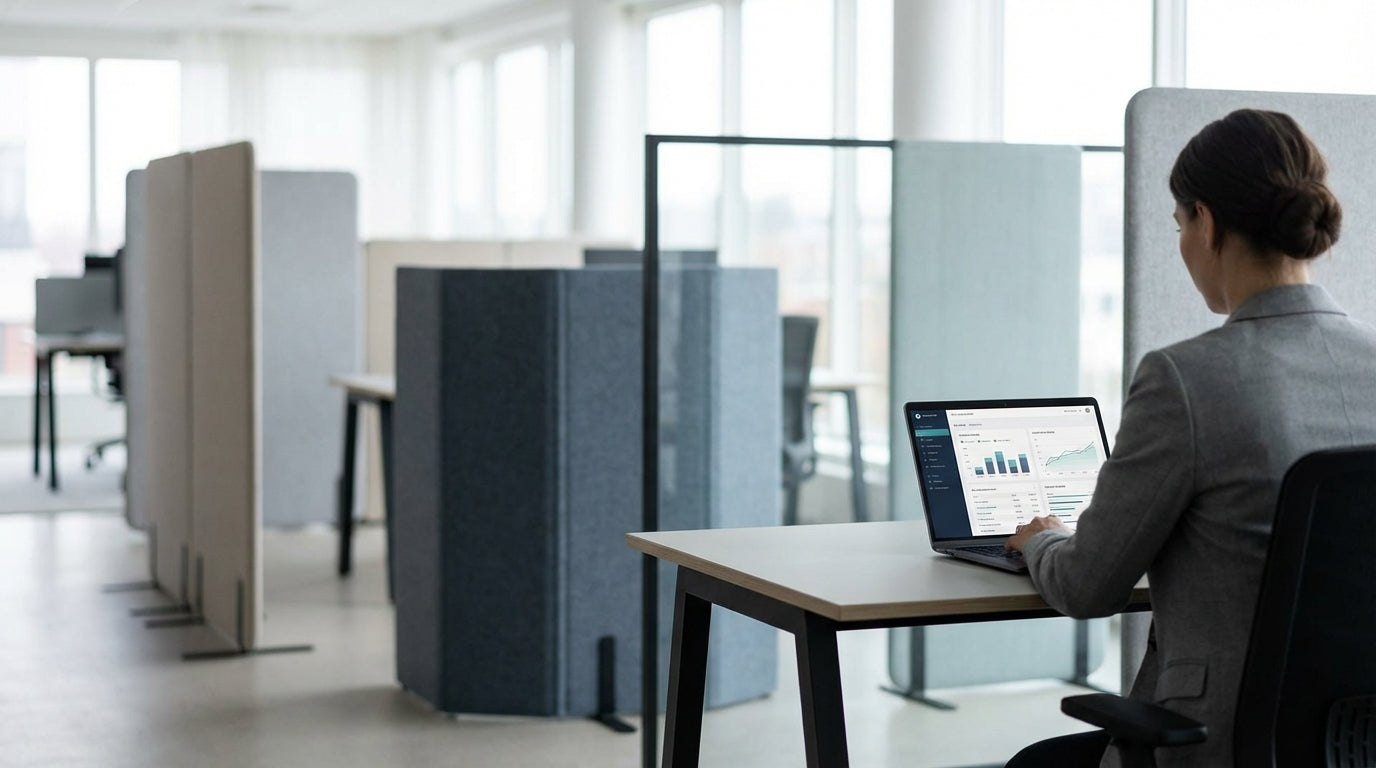
Understanding Floor Partitions in Modern Open-Plan Offices
Open-plan offices are great for collaboration, but they can quickly become noisy and distracting. Floor-standing partitions create structure without losing the sense of openness.
Floor partitions are freestanding panels that sit on the floor to divide space, rather than being attached to walls or desks. They can be used to create quiet zones, semi-private meeting spaces, or to separate different teams while still allowing for visual connection. Unlike fixed walls, they’re easy to move or reconfigure as your headcount or layout changes.
Because they’re non-permanent, floor dividers are ideal for growing businesses and flexible lease arrangements. You can start with a simple open layout, then gradually add panels, mobile partitions, and other modular elements as your needs evolve. This keeps fit-out costs down while still giving staff the privacy and focus they need.
Modern options go beyond plain fabric screens. You’ll find acoustic floor partitions, glass and polycarbonate panels, and integrated solutions that pair with partition workstations or shared 4 person workstations. Understanding these choices up front will help you design a workspace that supports productivity, wellbeing, and future flexibility.
Key Factors to Consider Before You Buy
A successful layout starts with understanding how your team actually works. Before ordering any floor dividers, take time to map out workflows, movement paths, and collaboration points.
Start by identifying zones that need extra privacy or acoustic control, such as HR, finance, and management areas. Look at where staff currently gather for impromptu chats or quick stand-ups, and consider using floor partitions to frame these spaces without fully enclosing them. Combining dividers with focused settings like single person workstations can create dedicated concentration areas away from high-traffic zones.
Traffic flow is another crucial factor. Position partitions so they guide people naturally around the office, rather than creating bottlenecks or blind corners. Think about access to shared resources such as printers, storage, and breakout spaces. In some cases, adding a couple of office pods near collaborative zones can absorb noise and provide a retreat for focused work or confidential calls.
Finally, factor in flexibility and growth. If your team size or work patterns are likely to change, prioritise modular systems and lighter floor partitions that can be reconfigured easily. Pairing them with scalable setups such as 2 person workstations or expandable 6 person workstations ensures your investment will keep working as your business evolves.
Acoustic Performance and Privacy in Open Spaces
Noise is the most common complaint in open-plan environments. Choosing dividers with good acoustic performance can dramatically reduce distractions and improve focus.
Look for floor partitions with sound-absorbing materials such as fabric-wrapped panels or specialised acoustic cores. These help soak up ambient noise rather than bouncing it around the office. For high-noise zones like sales, customer service, or creative studios, combining acoustic partitions with enclosed acoustic pods gives staff varied options for quiet work and confidential conversations.
Visual privacy matters just as much as sound. Higher panels, or a mix of solid and glazed sections, help reduce line-of-sight distractions without making the space feel closed in. When you’re designing desk clusters, floor partitions can work alongside desk mounted partitions to create multi-layered privacy: lower screens at desk level for seated work, and taller dividers between teams or departments.
Consider how the acoustic strategy connects across your layout, not just around individual desks. For example, you might group focused partition workstations behind a line of sound-absorbing floor screens, with nearby office pods for calls that need extra confidentiality. This zoning approach makes it clear where quiet work is expected, and where more open collaboration is encouraged.
Design, Materials, and Layout Integration
The right choice of materials and finishes will ensure your partitions support both aesthetics and performance. The goal is to define space without making it feel cramped or cluttered.
Fabric-covered panels are popular because they provide acoustic absorption and a soft, professional finish. You can use colour strategically: calm, neutral tones in focus areas; bolder shades in collaborative zones or around shared 4 person workstations. Glass or polycarbonate panels maintain light and visibility, ideal for reception areas or around leadership spaces where transparency matters.
Think about how your dividers work with existing furniture systems. For example, freestanding screens can be used to extend the privacy of single person workstations or to create semi-enclosed bays around 2 person workstations and 6 person workstations. If you already use desk mounted partitions, match or complement the finishes so the whole space feels cohesive.
Layout integration is where floor partitions really shine. You can create corridors, informal meeting spots, and touchdown zones simply by adjusting panel positioning. For agile environments, mixing fixed screens with mobile partitions allows you to switch between workshop mode and focused work mode quickly. When you need deeper focus or privacy, drop in enclosed options like acoustic pods or compact office pods next to your main workstation clusters.
Flexibility, Future-Proofing, and Product Options
Workplaces change fast, so your partition system should be easy to adapt. Flexibility reduces long-term fit-out costs and minimises disruption to staff.
Modular floor partitions let you add, remove, or reposition panels without tradespeople or major downtime. When combined with mobile partitions, you can quickly reconfigure spaces for training days, project kick-offs, or temporary team expansions. This is especially useful in hybrid workplaces where attendance patterns change from day to day.
Consider how floor dividers slot into your overall workstation strategy. Clustered layouts using partition workstations, 4 person workstations, or scalable 6 person workstations can be easily screened off or opened up depending on project cycles. For individuals who need regular quiet time, pair single person workstations with nearby acoustic pods or office pods to provide variety without redesigning the whole floor plate.
Future-proofing also means accommodating technology and new ways of working. Ensure there’s enough clearance around partitions for power and data runs, and keep pathways wide enough for equipment moves. By choosing a versatile combination of fixed and mobile dividers, plus complementary solutions like desk mounted partitions and mobile partitions, you’ll be able to fine-tune your open office layout as your team, tools, and workstyles evolve.


