

Understanding the key differences
Choosing between glass and traditional whiteboards comes down to how you work, your space, and your budget. Both options can be excellent if matched to the right environment.
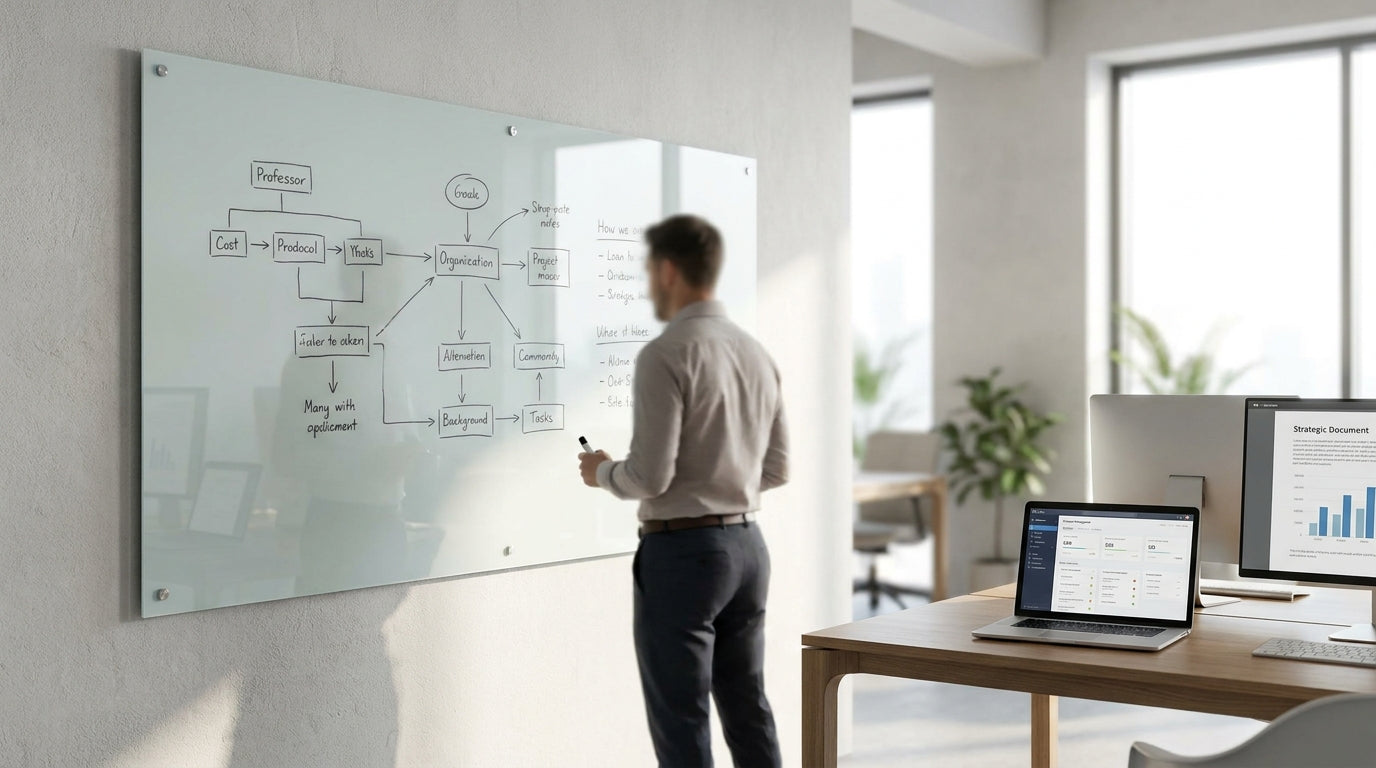
Traditional boards usually include melamine, porcelain, and magnetic whiteboards. These are the familiar white surfaces you see in classrooms and meeting rooms. Glass boards, by contrast, use toughened safety glass with a backing panel, giving a sleek, modern, frameless look that suits contemporary offices and client-facing spaces.
The surface material affects everything from how smoothly you can write to how easily the board cleans. Glass is non‑porous, so it resists ghosting (those faint marker stains that won’t quite wipe off), while lower-cost traditional boards can stain over time. Higher‑end options like porcelain whiteboards offer a more durable traditional surface that competes strongly with glass for longevity.
Mounting and mobility are another key difference. Glass boards are usually fixed to the wall as a permanent feature, whereas traditional boards are available in more flexible formats, including wall‑mounted, sliding rail systems, and mobile whiteboards on wheels. Thinking about whether you need a fixed focal point or a board that can move between rooms will quickly narrow your choices.
Performance, durability, and cleaning
If your team writes and erases all day, the surface quality and ease of cleaning really matter. This is where material choice can save money and frustration over time.
Glass boards are highly resistant to scratches, dents and stains. Their non‑porous surface means ink sits on top instead of soaking in, so even old text can usually be wiped clean with minimal effort. That makes glass a strong option for busy project rooms and creative spaces where notes stay up for days or weeks before being refreshed.
Traditional boards vary more. Entry‑level melamine can stain and ghost with heavy use, while premium porcelain whiteboards provide a harder, longer‑lasting surface that stands up well in schools and training environments. If you choose a traditional board, invest in good whiteboard accessories such as quality markers, erasers, and cleaning sprays, as these can significantly extend the life and appearance of the surface.
Magnetic performance is another factor. Many glass boards require extra‑strong rare‑earth magnets because the glass layer sits in front of the steel backing. In comparison, most steel or porcelain magnetic whiteboards work well with standard magnets, which can be more convenient for everyday classroom or office use. Consider what you’ll be pinning up — plans, notices, or printed slides — before you lock in a surface type.
Style, space, and how the board will be used
The right board should support how your team meets, plans, and presents, not just look good on the wall. Think about where and how it will be used day‑to‑day.
Glass boards are often chosen for their premium, architectural aesthetic. In reception areas, executive offices and client meeting rooms, they double as both a writing tool and a design feature. When combined with projection boards & presentation accessories, they can help modernise a boardroom setup, although glass itself is usually too reflective for serious projection work.
Traditional surfaces come into their own when you need specialised layouts. For example, planner & specialty whiteboards offer printed grids, calendars, and scheduling templates that are ideal for rostering, job tracking, or classroom timetables. In these cases, the functional layout often matters more than the visual impact, making a high‑quality traditional board the better fit.
Don’t forget the broader communication ecosystem in your workspace. For static information, noticeboards & display cases may suit better than a writable surface at all. For tech‑heavy environments, pairing a standard board with electric interactive whiteboards can give teams both quick scribble space and full digital collaboration tools, without relying on glass for every wall.
Budget, installation, and safety considerations
Cost and installation are often the deciding factors once you’ve narrowed down the style and performance you need. It’s worth looking at the total cost of ownership, not just the purchase price.
Glass boards generally sit at the higher end of the price range due to toughened glass, hardware, and more complex mounting requirements. However, their long life and resistance to ghosting can make them cost‑effective for high‑use spaces where cheaper surfaces would need replacing more frequently. In contrast, traditional boards, particularly melamine, are more budget‑friendly up front and easier to swap out later if your needs change.
From an installation perspective, glass is heavier and usually requires solid wall fixing and careful handling. This may mean engaging professional installers, especially for larger panels in meeting rooms. Standard wall‑mounted and mobile whiteboards are lighter and quicker to set up, giving you flexibility if you’re fitting out a growing office or temporary training space.
Safety is also important, especially around students or the public. Quality glass boards use toughened safety glass that’s designed to minimise risk if broken, but it is still glass and needs appropriate mounting. Traditional options like porcelain whiteboards and steel‑backed magnetic whiteboards offer robust, impact‑resistant surfaces that are proven in schools, healthcare, and high‑traffic corridors.
Making the right choice for your workplace
Bringing everything together, the best board is the one that matches how you actually work. A quick checklist can help you decide confidently.
If you prioritise a modern look, minimal ghosting, and a permanent feature wall in a client‑facing space, a glass option is likely to serve you well. For flexible, everyday use across classrooms, training rooms or rotating project teams, a mix of traditional boards, including magnetic whiteboards and mobile whiteboards, can give you more adaptability at a lower overall cost. Adding the right whiteboard accessories — markers, erasers, cleaning kits and magnets — will keep whatever surface you choose working smoothly for longer.
Consider whether you also need structured planning tools or digital integration. Planner & specialty whiteboards are ideal for visual management, job boards and shift planning, while electric interactive whiteboards support video calls, annotations, and saving notes directly to your computer. Pairing these with dedicated projection boards & presentation accessories creates a complete communication hub for training and presentations.
Finally, think of your space as a whole rather than picking surfaces in isolation. Combine writable boards with noticeboards & display cases for policies, safety information, or long‑term announcements, and you’ll avoid clutter on your writing surfaces. By matching surface type, layout, and technology to each room’s purpose, you can build a workspace that looks professional, supports collaboration, and stays easy to maintain over the long term.


