

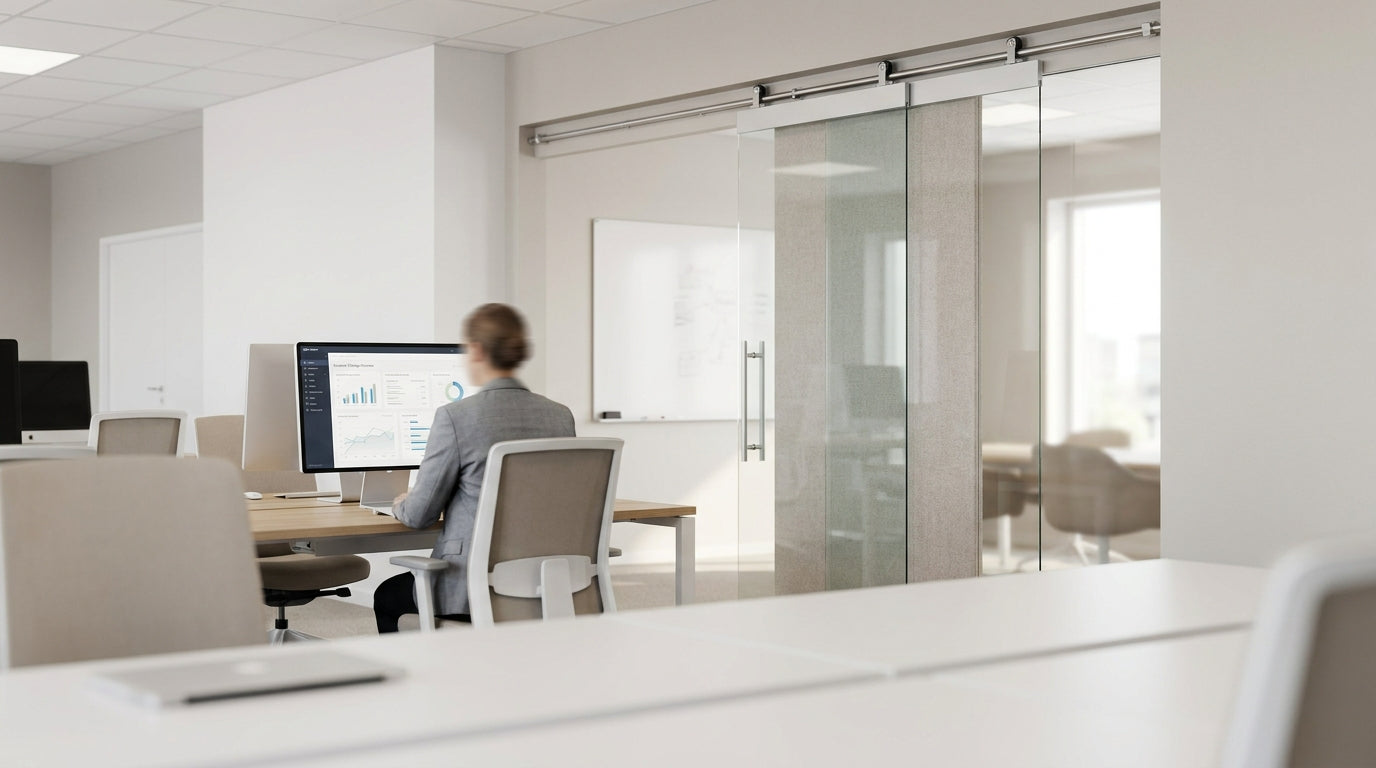
Understanding Movable Office Dividers on Rails
Movable office dividers on rails let you reconfigure space quickly without permanent building work. They’re ideal for open-plan offices, training rooms, and shared work zones that need flexibility.
At their core, these systems are panels mounted on a ceiling or floor track, allowing you to slide and stack them as needed. Some models fold like an accordion, while others run as individual sliding panels that park neatly to one side. Compared with fixed Floor Partitions, rail-mounted options give you more control over room size, flow, and privacy throughout the day.
In modern hybrid workplaces, they’re often paired with focused spaces such as Office Pods and enclosed booths. This mix helps you support collaboration, quiet work, and informal meetings without committing to a full office fit‑out. The right configuration can also work alongside open Partition Workstations to create logical zones for teams.
If you already use modular furniture, these dividers extend that same flexibility to your walls. As teams grow or layouts change, you can redesign the floorplan by sliding panels rather than moving heavy furniture or calling in trades. That makes them particularly appealing for co-working hubs, project-based teams, and fast-growing businesses.
Assessing Space, Layout, and Workflow
Before choosing any rail-mounted divider, you need a clear picture of how your space works day to day. Start with where people actually sit, move, and meet.
Walk the office at different times and note where noise builds up, where meetings spill into circulation areas, and which corners sit underused. Compare this with where you’ve placed desks, such as Single Person Workstations for focus tasks or collaborative layouts like 2 Person Workstations and 4 Person Workstations. This will highlight the zones that need better separation or more flexibility.
Consider traffic paths to amenities, printers, and breakout areas so that your new dividers don’t create bottlenecks. Sliding panels on rails should guide movement, not block it. If you’re zoning a large bank of Partition Workstations, think about how people will enter and exit without disturbing colleagues. The aim is to balance privacy with easy access.
Ceiling height, structural beams, and existing services (like air‑conditioning and sprinklers) also matter. Some rail systems fix to the ceiling, while others are top-hung with minimal floor tracks. Measure carefully and map out where tracks can run without clashing with lights or ductwork. For mixed spaces that already use Desk Mounted Partitions, make sure the new layout keeps sightlines and emergency exits clear.
Key Features and Materials to Compare
The right choice comes down to how much privacy, acoustic control, and durability you need. Each feature will impact cost and day‑to‑day usability.
Acoustic performance is one of the biggest considerations. If you’re dividing training rooms, project areas, or phone‑heavy zones, look for panels with sound‑absorbing cores or fabric finishes. These can work alongside standalone options like Mobile Partitions and acoustic Floor Partitions to tame echo in open spaces. For quieter offices, lightweight laminate or glass panels may be enough, offering visual separation without fully blocking noise.
Materials also affect light and openness. Full-height solid panels maximise privacy but can make small offices feel closed in. Part‑glazed or fully glazed sections keep natural light flowing to staff at Single Person Workstations and collaborative desks. If you’re pairing dividers with enclosed solutions like Office Pods, choose finishes and colours that align with your broader fit‑out so the space feels cohesive, not pieced together.
Don’t overlook hardware quality. Smooth, quiet rollers and robust tracks are essential if you’ll be reconfiguring rooms daily. Check that locking mechanisms are simple enough for staff to use without tools, yet secure once in place. Where panels interface with desks or storage, consider adding Workstation Components and modesty panels for a clean, finished look. Accessories like organisational rails or coat hooks, similar to those found in Screen Accessories, can add extra function to each wall section.
Integration with Workstations and Focus Areas
Sliding dividers work best when they complement your existing work settings, not compete with them. The goal is to support different work styles in the same floorplan.
For individual focus work, consider how rails can carve out quiet pockets around Single Person Workstations without isolating staff completely. You might use partial-height panels or glazed sections so people feel connected yet protected from distractions. In busier zones with 2 Person Workstations or 4 Person Workstations, movable walls can create project “neighbourhoods” that expand or contract depending on team size.
Combine rail-mounted systems with fixed Desk Mounted Partitions to shape personal space. Desk screens handle close‑range privacy and cable management, while the larger dividers define the overall room. Where a permanent wall would be too rigid, a mix of Partition Workstations and sliding panels lets you adjust layouts for workshops, presentations, or onboarding sessions.
For high-focus activities and confidential conversations, consider pairing these systems with enclosed Office Pods. Pods give you fully contained spaces for calls and deep work, while the surrounding rails create semi‑private collaboration areas. To finish the setup, you can add complementary Workstation Components such as storage, modesty panels, or cable channels so each zone feels intentional and well-resolved.
Practical Buying Tips, Safety, and Maintenance
A good specification balances flexibility, safety, and long-term value. Taking time to plan now will save you headaches after installation.
Confirm local building and fire regulations before committing to any system, especially in shared or multi-tenant buildings. You’ll need to keep exit paths and access to fire equipment clear, even when panels are fully extended. Panelling near desk clusters or Partition Workstations should not block sprinklers or emergency signage. Ask suppliers for documentation on acoustic ratings, fire performance, and load limits for the rails.
Safety in everyday use is just as important. Ensure tracks are installed level and securely fixed, with no trip hazards at thresholds. Test how easily staff can move and lock the panels; if the system is too heavy or fiddly, it won’t be used as intended. In dynamic spaces that also rely on freestanding Mobile Partitions, consider colour-coding or simple plans so teams know which elements they can move themselves.
Maintenance is usually straightforward but should be planned. Schedule periodic checks to clean tracks, inspect rollers, and adjust any hardware that loosens over time. Choose finishes that are easy to wipe down in busy areas and that match other surfaces such as Floor Partitions or desk screens. When you need to refresh the space, it’s often simpler to update panel fabrics or add new Screen Accessories than to undertake major building work, keeping your office adaptable as your business evolves.


