

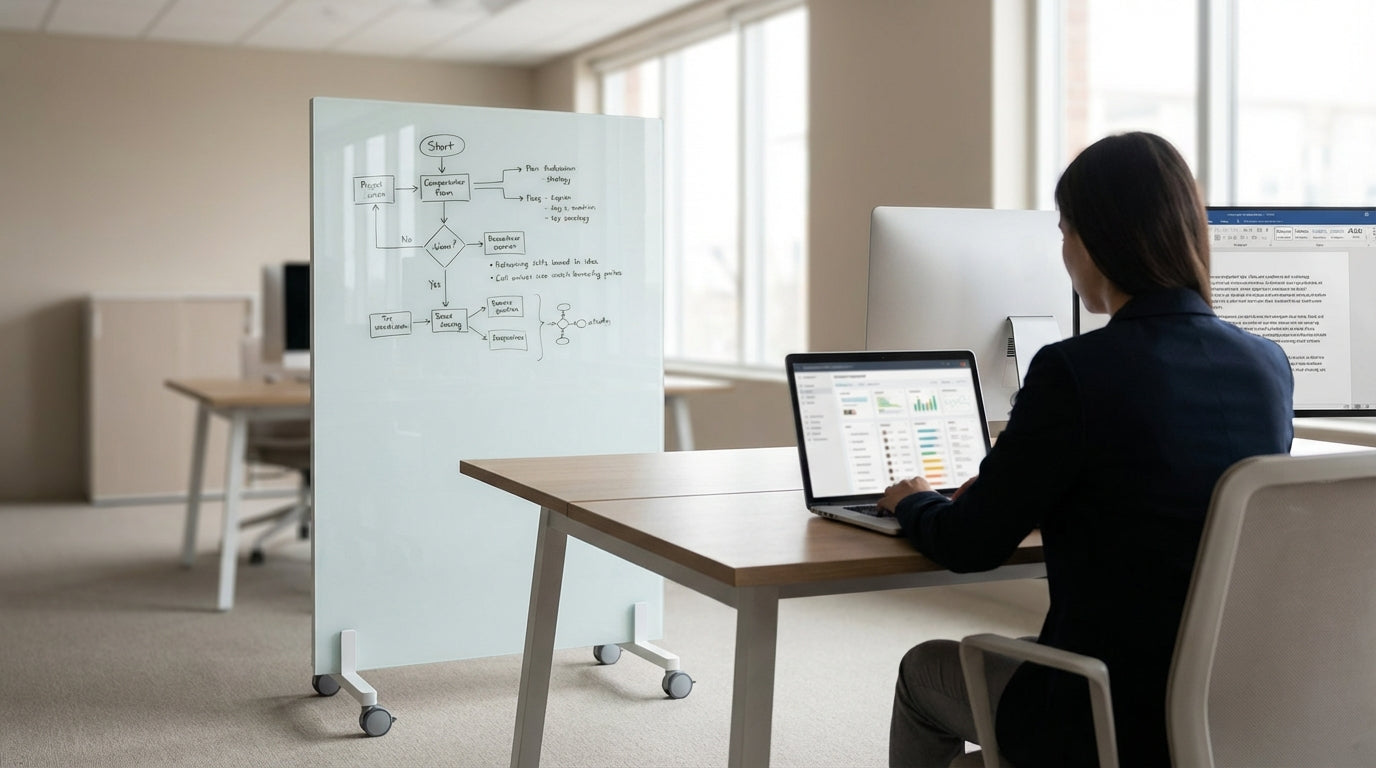
Why Agile Teams Rely on Mobile Whiteboards
Agile workspaces thrive on visibility, quick collaboration, and constant iteration. Mobile whiteboards give teams a flexible surface to capture ideas, map workflows, and pivot fast without being tied to a wall.
Unlike fixed boards, quality Mobile Whiteboards can move with your team between stand‑ups, project huddles, and client presentations. They act as portable “information radiators”, making tasks, priorities, and risks obvious to everyone in the room. This is especially useful in hybrid environments, where physical boards complement digital tools like Jira or Trello by giving people in the office a shared focal point.
In Australian offices where space is at a premium, mobile options let you convert any corner into a project zone or temporary war room. Pairing boards with well‑placed Mobile Partitions can quickly carve out collaboration areas without a full office refit, supporting flexible seating and changing team sizes.
For agile ceremonies like daily stand‑ups, sprint planning, and retrospectives, rolling boards can be positioned to minimise glare, fit the group size, and stay visible on video calls. Combined with fit‑for‑purpose Meeting Tables and other Office & Meeting Tables, you can build zones where conversation flows naturally around the board rather than people crowding awkwardly against a fixed wall.
Comparing Surface Types for Daily Agile Use
The writing surface you choose affects durability, legibility, and ease of cleaning. Matching the surface to your team’s usage patterns will save time and money over the long term.
Standard melamine Mobile Whiteboards suit light, occasional use, but they can stain over time if left with ink for days. For busy agile teams running multiple stand‑ups and workshops daily, it’s usually worth upgrading to Magnetic Whiteboards or premium Porcelain Whiteboards. Porcelain (sometimes called vitreous enamel steel) is highly resistant to ghosting, which means old writing doesn’t faintly linger on the surface after cleaning.
Glass options provide a modern look and exceptional stain resistance. Glass Whiteboards are ideal for executive spaces, design studios, and client‑facing areas where presentation matters as much as function. They offer smooth writing and easy erasing, though you’ll want to ensure adequate contrast between marker colours and the background, particularly in rooms with strong natural light.
Magnetic surfaces are especially helpful in agile environments because they let you mix handwriting with cards, printed tickets, and colour‑coded indicators. High‑quality Magnetic Whiteboards combined with the right Whiteboard Accessories such as magnets, status labels, and card holders make it easy to reorganise workflows during planning sessions without constantly rewriting. If you need structured layouts, consider Planner & Specialty Whiteboards with printed grids or calendars to support Kanban boards, sprint timelines, or release roadmaps.
Size, Height, and Mobility Features That Matter
Agile teams need boards that are big enough to see, but easy enough to move and store. Balance visibility with your available floor space and storage options.
Start by mapping where your team normally gathers and how far away people stand during stand‑ups or workshops. For medium to large rooms, a taller, wider unit from the Mobile Whiteboards range ensures that user stories, swimlanes, and metrics are readable from the back of the room. Look for adjustable or double‑sided models to increase writing space without eating into extra floor area, particularly in compact Australian offices where every square metre counts.
Wheel quality and base design are just as critical as the surface itself. Stable, lockable castors prevent wobble during writing and keep the board safely in place on hard floors or low‑pile carpet. A well‑designed frame also allows the board to be wheeled through standard doorways and lifts, so you can move it between project rooms or levels as teams reorganise.
Height adjustability is valuable when your workforce includes a mix of sitting and standing users, or when you regularly host workshops with clients of varying heights. When paired with the right Office & Meeting Tables, you can ensure people can write comfortably without overreaching or bending. Consider where you’ll store the boards after sessions; slimmer frames and stackable bases help you park several units neatly against a wall or behind Mobile Partitions when not in use.
Integrating Boards with Agile Rituals and Layouts
Whiteboards are most effective when they’re baked into everyday agile rituals. Plan your layout so they support, rather than interrupt, the flow of work.
For daily stand‑ups, position a mobile unit near the team’s usual working area and close to key Meeting Tables for quick note‑taking. One side can host the current sprint board, with columns for “To Do”, “In Progress”, “Blocked”, and “Done”, while the other side can hold long‑term goals or metrics. If your squad runs parallel streams (such as product and tech debt), consider multiple boards from the Mobile Whiteboards range to keep each stream clear instead of crowding everything onto one surface.
For planning and retrospectives, it helps to mix structured and open layouts. Pre‑printed Planner & Specialty Whiteboards can handle calendars, capacity charts, and release roadmaps, freeing up plain Magnetic Whiteboards for sticky notes and quick sketches. This structure speeds up ceremonies because the framework is always ready; teams simply update content instead of redrawing grids each time. Border tape, coloured magnets, and other Whiteboard Accessories make it easy to define lanes and categories without permanent markers.
Think beyond classic agile boards as well. Design teams may favour Glass Whiteboards for wireframes and storyboards, while operations or HR squads might use Porcelain Whiteboards for process maps that stay up longer. Creating “information hubs” by combining several mobile units with Mobile Partitions can give each crew a semi‑permanent project area, even in hot‑desking environments.
Accessories and Maintenance for Long-Term Value
The right accessories and care regime will keep your boards clean, legible, and ready for every sprint. This protects your investment and reduces frustration for the team.
Start with good quality markers, erasers, and cleaning sprays from a dedicated Whiteboard Accessories range. Cheap markers often cause ghosting or leave residue that’s hard to remove, especially on heavily used agile boards. Microfibre cloths and regular cleaning routines are crucial if your team updates boards several times a day; schedule quick wipe‑downs at the end of stand‑ups or before retrospectives so surfaces stay fresh and easy to read.
Magnetic tools make agile workflows more tactile and flexible. Combine Magnetic Whiteboards or compatible Porcelain Whiteboards with coloured magnets, card holders, and status flags to highlight priority items, dependencies, or blocked tasks. Label strips and magnetic headings help standardise columns across different teams, so anyone can understand a board at a glance when moving between projects or rooms.
Finally, protect frames and wheels by moving units carefully around Office & Meeting Tables and other furniture, and always lock castors before writing. If your space is frequently reconfigured, consider grouping mobile units and Mobile Partitions in designated storage zones to avoid knocks and scratches. With the right combination of well‑chosen boards, smart accessories, and consistent upkeep, your agile workspace will stay visually organised and ready to support fast, effective collaboration.


