

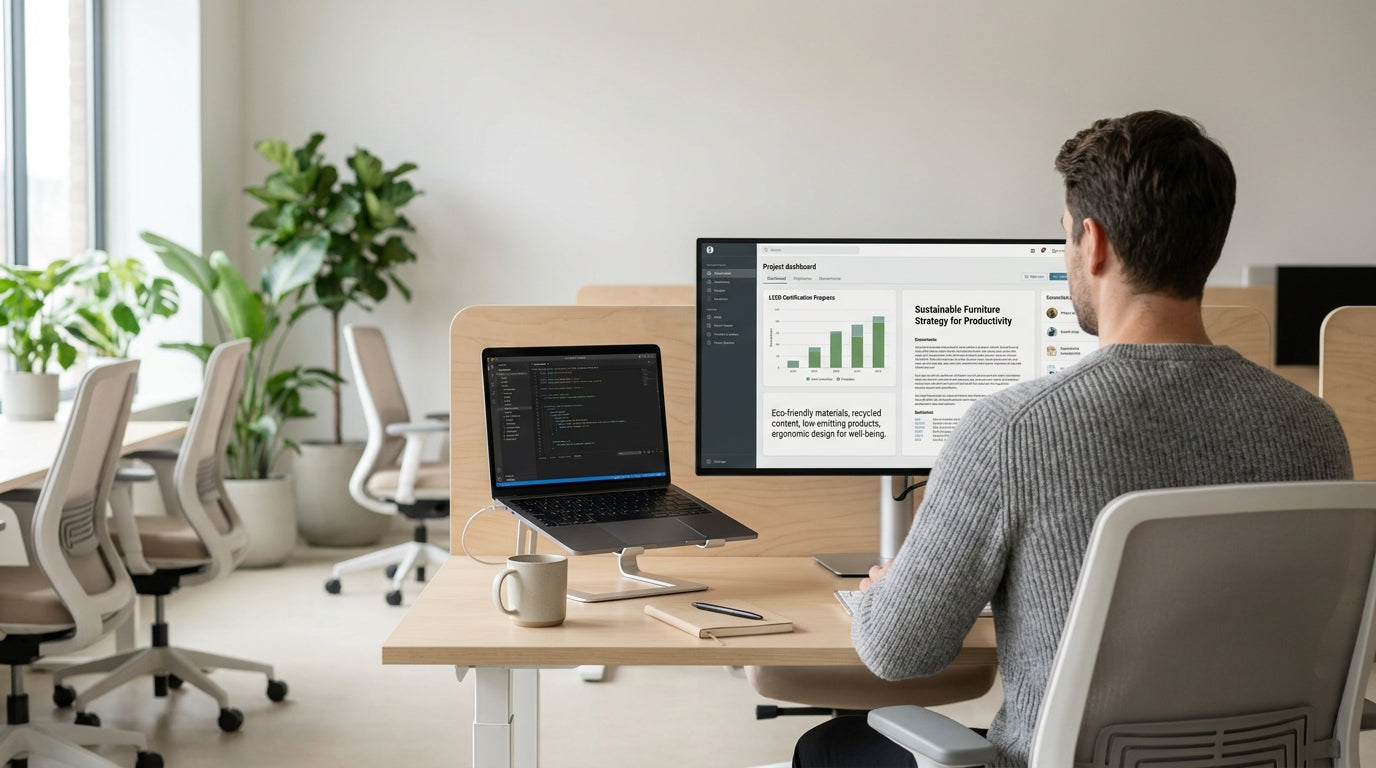
Understanding LEED Requirements for Office Fitouts
Designing a workplace to meet LEED standards means thinking beyond looks and price. Furniture choices directly affect energy use, indoor air quality, acoustics, and staff wellbeing.
LEED (Leadership in Energy and Environmental Design) is a global green building rating system that rewards projects for reducing environmental impact. When it comes to commercial furniture, the key criteria usually relate to low-emission materials, recycled content, responsible sourcing, and how easily items can be reused or recycled at end of life. Documented certifications for timber, textiles, and finishes can help support your LEED credits and simplify compliance during the assessment phase.
In practical terms, that means checking whether desks, chairs, and storage use low-VOC (volatile organic compound) adhesives, paints, and laminates, and whether foam or upholstery is independently tested for emissions. It also means understanding how flexible your furniture is. Modular items like Height Adjustable Workstations or reconfigurable Partition Workstations can adapt to new layouts without the waste of constant replacement, supporting both sustainability goals and long-term cost control.
Remember that LEED evaluates the whole building, not just individual pieces. Your procurement strategy should align with your mechanical, lighting, and acoustic design so that workstations, task seating, and focus areas all work together to reduce energy consumption and improve occupant comfort. When you treat furniture as part of the building ecosystem rather than a separate purchase, it becomes far easier to hit your required rating.
Prioritising Sustainable Materials and Low Emissions
Material choice is one of the biggest levers you have for greener office furniture. Look for durability, recyclability, and low toxicity before you look at colour swatches.
Start by asking suppliers for evidence of sustainably sourced timber, recycled steel and aluminium, and fabrics with reduced chemical treatments. Locally manufactured seating, such as Australian Made Chairs, can also cut down on transport emissions and support Australian standards for quality and safety. In many cases, robust local manufacturing gives you clearer traceability around supply chains, which is valuable when compiling LEED documentation.
Indoor air quality is a critical LEED category, so prioritise furniture with low-VOC finishes. VOCs are chemicals that off-gas from paints, glues, and foams and can cause headaches, irritation, or longer-term health issues. Choosing workstations, task chairs, pods, and partitions with independently tested low-emission components helps keep pollutants out of the workspace, supporting both compliance and staff wellbeing.
It is also worth considering the full lifecycle of each item. Can the frame, top, and mechanical components of your Height Adjustable Workstations be repaired or replaced individually? Are your Australian Made Chairs designed for easy reupholstery rather than landfill at the first sign of wear? Products built for disassembly and refurbishment reduce long-term waste and can be reconfigured as your headcount and floor plan evolve.
Designing Flexible, Space-Efficient Work Zones
Efficient space planning supports both sustainability and productivity. Smaller, smarter footprints typically demand less energy for lighting, heating, and cooling.
Modern workstation systems make it easier to right-size your layout to actual team needs. For focused individual work, Single Person Workstations can be deployed in dense but comfortable configurations, often with integrated cable management to reduce clutter and hazards. Where collaboration is the priority, benching solutions such as 2 Person Workstations, 3 Person Workstations, and 4 Person Workstations allow you to share legs, power, and screens instead of duplicating components for every desk.
Partitioned systems can further refine your space planning for LEED-aligned projects. Using Partition Workstations, you can create semi-enclosed zones that improve acoustic comfort and focus while still keeping the overall plan open enough to maximise daylight penetration from windows and skylights. This balance is important, because good daylight access can contribute to LEED points while reducing the need for artificial lighting during business hours.
Height adjustability adds another layer of flexibility. With Height Adjustable Workstations, the same footprint can accommodate different body types, job roles, and working styles without additional furniture. This not only supports ergonomic best practice and staff health, it reduces the churn of furniture purchases when teams change or hot-desking grows. Over time, using fewer, more adaptable pieces is both more sustainable and more economical.
Improving Acoustics and Wellbeing with Pods and Partitions
Noise control is often overlooked in sustainable office design, but it strongly affects performance and comfort. Well-chosen acoustic furniture can help you meet LEED targets around indoor environmental quality.
In open-plan environments, dedicated quiet spaces reduce stress and distraction. Office Pods provide enclosed areas for calls, focused work, or private meetings without the need for permanent construction. Because pods are modular and mobile, they support adaptive reuse of your floorplate, allowing you to respond to changing team sizes or hybrid work patterns without new walls, doors, or major fitout works.
Where sound is a major issue, Acoustic Pods use specialised panels and seals to absorb and block noise. This can be especially effective in dense workstation layouts built around 2 Person Workstations or larger shared benches such as 3 Person Workstations and 4 Person Workstations. By providing quiet alternatives nearby, you reduce pressure on meeting rooms and support concentration-intensive tasks without isolating staff from the rest of the team.
Partitions also play a role in acoustic management. Incorporating Partition Workstations with fabric or acoustic-panel screens helps dampen sound between neighbouring desks, reducing the perceived noise level in busy areas. Combined with ergonomic seating such as Australian Made Chairs and sit-stand surfaces from your Height Adjustable Workstations range, you can design zones that support both mental focus and physical comfort—two critical ingredients of a truly sustainable workplace.
Balancing Ergonomics, Compliance, and Long-Term Value
Green buildings still need to be comfortable, safe, and cost-effective. The most sustainable furniture is the kind that staff actually want to use for many years.
Ergonomic design should be non-negotiable. Adjustable seating, like well-designed Australian Made Chairs, paired with Height Adjustable Workstations, helps reduce musculoskeletal strain and supports healthy movement throughout the day. When people are comfortable, they are less likely to request modifications or replacement items, which cuts down on waste and unforeseen procurement.
From a compliance and documentation perspective, working with recognised product lines can simplify the LEED submission process. Being able to demonstrate that your Single Person Workstations, shared benches such as 2 Person Workstations, 3 Person Workstations, and 4 Person Workstations, plus your Office Pods and Acoustic Pods, all meet relevant standards streamlines coordination between your project team, certifier, and suppliers. Detailed specifications, test reports, and warranties all help to build a clear evidence trail.
Finally, consider the total cost of ownership rather than the initial purchase price. Robust workstation systems and Partition Workstations that can be rearranged, extended, or reduced as your tenancy evolves will nearly always deliver better value than cheaper, inflexible options. By investing in repairable frames, replaceable tops, and easily updated finishes, you support LEED principles around resource conservation while creating an office environment that can grow and adapt with your organisation over time.


