

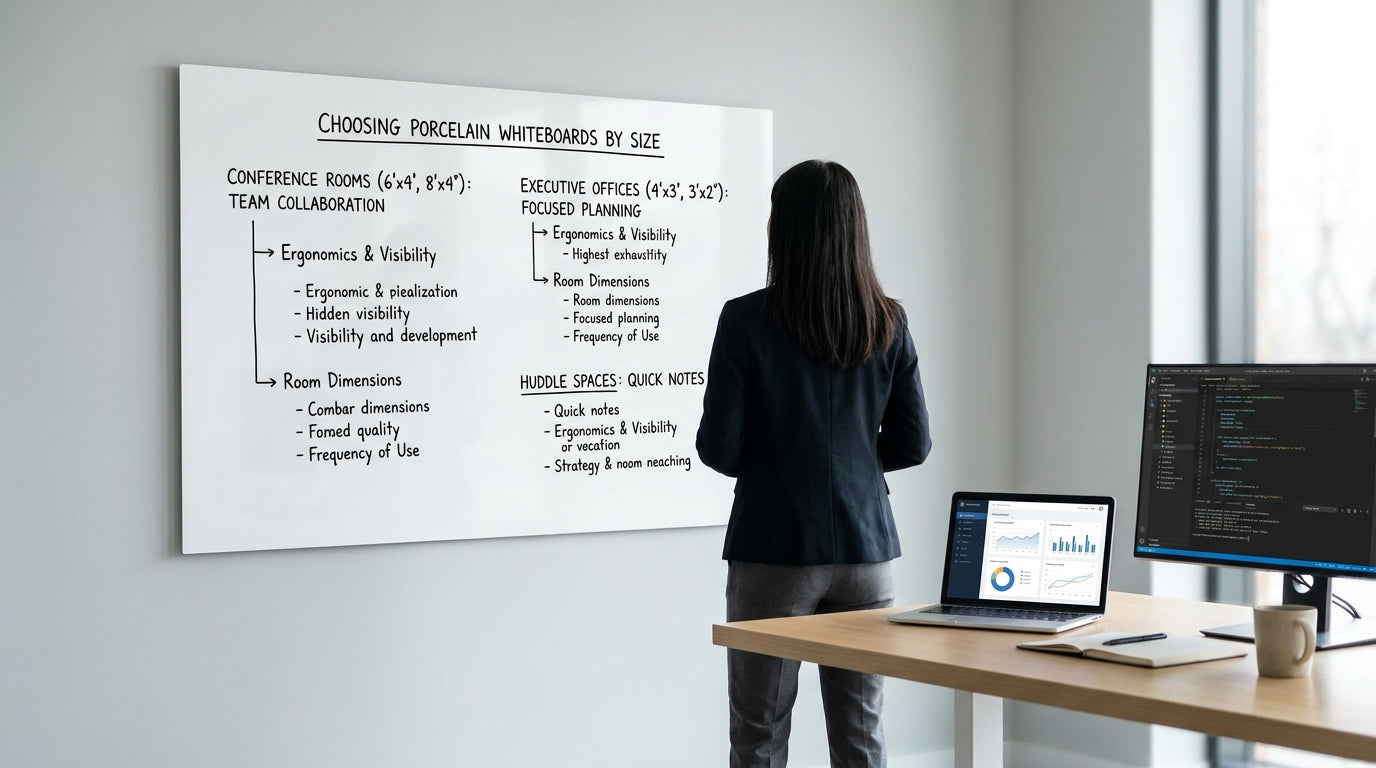
Understanding Standard Whiteboard Dimensions
Before you buy, it helps to know what sizes are commonly available and what they actually mean in practice. Dimensions are usually listed in millimetres or centimetres, but it’s worth visualising them on your wall or floor first.
Most wall-mounted porcelain whiteboards range from compact 600 x 450 mm boards right up to 3000 x 1200 mm for large training rooms and classrooms. Smaller boards suit personal offices or tight spaces, while medium sizes (around 1500 x 900 mm) cover everyday team meetings and lesson plans. Large boards create a focal communication wall, ideal when multiple people are contributing ideas at once.
Think about how you’ll use the board across a full day or week, not just for a single meeting. If you regularly run workshops, pair a larger wall board with mobile solutions like mobile whiteboards for breakout groups and rotating activities. Matching the format and size to real tasks will give you far better value than choosing on price alone.
It’s also worth noting that the frame and mounting hardware add a little to the overall footprint. When measuring, allow clearance at the sides and above for installation, particularly if you’re positioning the board near windows, cupboards, or projection screens such as dedicated projection boards & presentation accessories.
Matching Board Size to Room Type and Layout
The right size in a small office may be completely wrong in a large training space. Start with the room, not the board.
In individual offices or home workspaces, compact boards that sit above a desk are usually sufficient. A 900 x 600 mm or 1200 x 900 mm surface gives you space for task lists, quick diagrams, and weekly plans without overwhelming the wall. Pairing a modest board with storage for whiteboard accessories keeps the area tidy and functional.
For meeting and conference rooms, plan around the seating layout. If attendees sit around a central table, such as dedicated meeting tables, choose a board wide enough that people at each side can see clearly without moving their chairs. Longer boards (1800 mm and above) usually suit these spaces, especially when used with presentation accessories for hybrid meetings or video calls.
Training rooms and classrooms often benefit from multiple writable surfaces rather than a single oversized one. You might install one main porcelain board at the front and use additional mobile whiteboards for group tasks, or combine a traditional board with electric interactive whiteboards to handle digital content. Matching the size and quantity of boards to the teaching style makes sessions smoother and more engaging.
Considering Viewing Distance and Readability
A big board isn’t useful if people at the back still can’t read it. Think about how far away your audience will be.
A simple rule of thumb is: the further away people sit, the larger your writing and diagrams need to be. For board content to stay legible, there should be a balance between board size and viewing distance. For example, in a long training room with rows of training tables, a narrow board will force you to cram content together, making it difficult for participants in the back row to follow along.
The finish of the surface also affects clarity. High-quality porcelain offers a smooth, low-glare writing surface that is easier to read under bright lights than many budget boards. If you plan to project onto your whiteboard as well as write, consider pairing porcelain surfaces with appropriate projection boards & presentation accessories or using dedicated glass whiteboards and keeping the main board for written content only.
In larger rooms, you may find that two medium-sized boards on adjacent walls are more effective than one oversized unit. This allows you to keep critical information on one surface and use the other for brainstorming or temporary notes. Supplementing wall boards with magnetic whiteboards on easels or mobile frames can also help you bring key points closer to different groups as needed.
Balancing Writing Space, Storage and Other Wall Uses
Your wall has to do more than hold a board. Take into account windows, shelves, screens, and storage when deciding how much space you can dedicate to writing surfaces.
Begin by mapping out the entire wall area, including doors, built-in cupboards, TVs, and existing shelving. Aim to place the board at a height where the main writing area is roughly at eye level for the average user. In multi-user environments, you may compromise slightly so both taller and shorter team members can write comfortably, or complement a large fixed board with height-flexible mobile whiteboards.
If you frequently use magnets for charts or printed documents, make sure the board’s size supports your typical layout. Many teams combine a larger writing area with smaller planner & specialty whiteboards for calendars, Kanban boards, or staff rosters. This avoids cluttering your main surface while still keeping everything visible and organised.
Consider how close the board sits to furniture. Boards placed directly above deep credenzas or storage units can be harder to reach across, especially when you’re writing near the top. Keeping markers, erasers, and other whiteboard accessories on a dedicated tray or nearby shelf will help you use the full board area efficiently without constantly hunting for supplies.
Choosing the Right Combination of Boards for Flexible Spaces
Many modern offices and schools use flexible spaces rather than single-purpose rooms. In these environments, a mix of board sizes and types often works best.
If your space regularly shifts between training, workshops, and project work, combine a central porcelain board with movable surfaces that can be reconfigured on the fly. For example, fixed wall boards for structured content, plus mobile whiteboards that can divide the room or follow breakout groups. This approach lets you keep a permanent “reference” area while still encouraging collaboration anywhere in the room.
Technology can further influence your choice. Integrating electric interactive whiteboards gives you digital tools for remote participants and complex presentations, while nearby porcelain or magnetic whiteboards provide a quick, low-tech space for sketching ideas. In smaller rooms, you might prioritise one larger interactive screen with a more compact traditional board to avoid overwhelming the walls.
Don’t forget aesthetics and long-term durability. Quality porcelain surfaces pair well with modern glass whiteboards in design-led offices, while specialty formats like planner & specialty whiteboards keep recurring information neat and legible. By thinking through how each surface will be used, and how it will work with your furniture such as training tables and meeting tables, you can choose board sizes that support both day-to-day tasks and future growth.


