

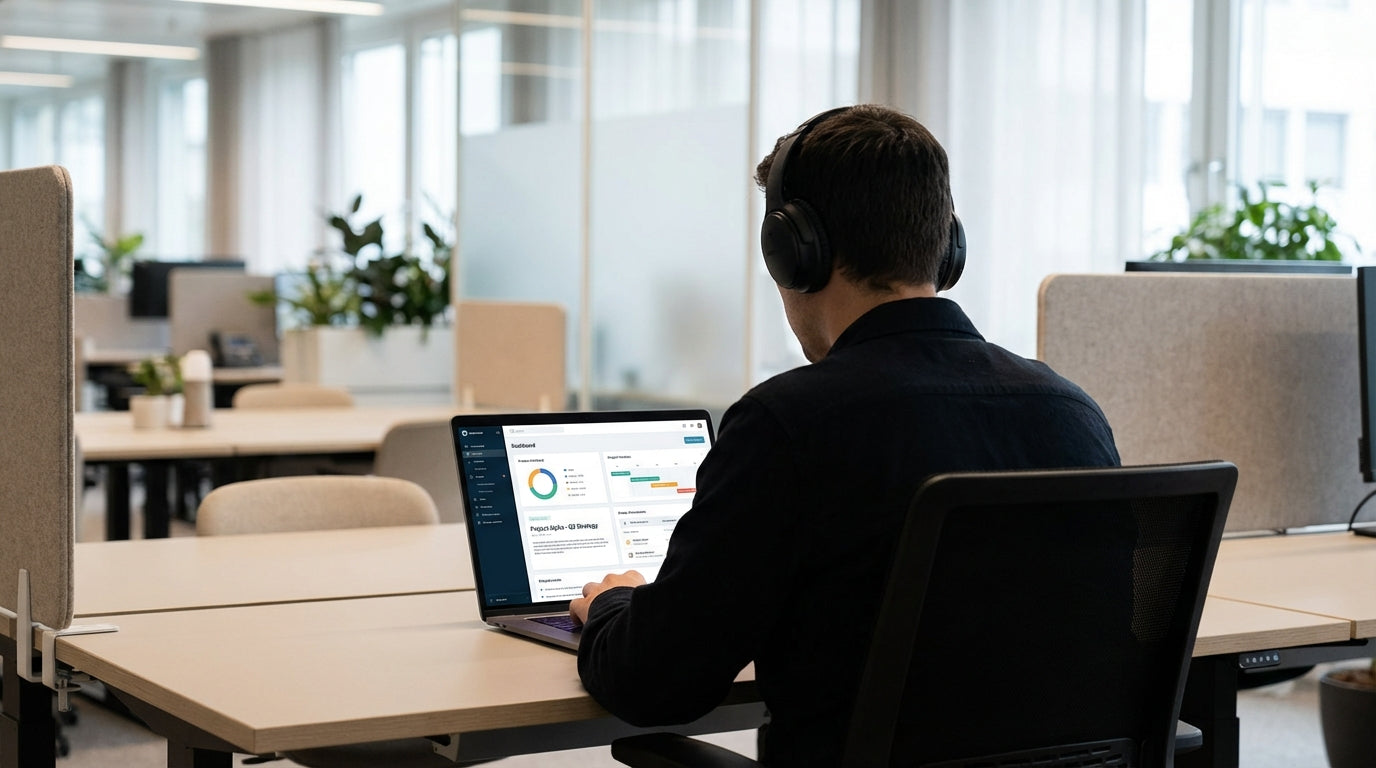
Why Privacy Matters in Open Plan Workspaces
Open plan offices are popular, but they can be noisy, distracting, and stressful without proper privacy solutions. The key is to support focus and confidentiality without losing the benefits of collaboration.
When people work in a shared space, sound, movement, and visual distractions constantly compete for attention. This can reduce productivity, increase mistakes, and make confidential conversations difficult. By planning for both acoustic and visual privacy, you can create zones for deep work, quick chats, and team collaboration within the same footprint.
Privacy is not just about hiding people away; it’s about giving employees a sense of control over how and where they work. That might mean quiet areas for phone calls, semi-enclosed desks for focus, or small enclosed rooms for sensitive discussions. A mix of furniture, partitions, and acoustic treatments lets you fine-tune each area instead of relying on a one-size-fits-all layout.
Modern workspace design focuses on “activity-based working”, where areas are tailored to tasks rather than fixed desks alone. Privacy solutions that are flexible, movable, and scalable fit neatly into this approach, allowing the office to adapt as teams, projects, and technology change.
Using Zoning and Partitions to Define Quiet Areas
Dividing an open space into clear zones is one of the most effective ways to support privacy. Physical boundaries help signal when an area is meant for focus, collaboration, or quick catch‑ups.
Workstation clusters with integrated panels, such as Partition Workstations, are a practical starting point. These arrangements create semi-enclosed spaces that reduce both visual interruptions and noise spread, while keeping teams close enough for easy communication. For desks that are already in place, adding Desk Mounted Partitions can instantly lift privacy without a full redesign.
Where you need to define walkways, breakout zones, or quiet corners, freestanding Floor Partitions are ideal. They act like internal walls but can be moved or reconfigured as your layout changes. This flexibility lets you test different zoning strategies, such as creating a ring of focus desks around a collaborative hub, without committing to permanent construction.
If your team often re-shuffles or you host different project groups, Mobile Partitions make it easy to re‑zone the floor on demand. These movable screens can quickly create pop‑up privacy for workshops, interviews, or temporary project rooms. Transparent or semi-transparent Acrylic Screens are also useful when you want to reduce distraction and airflow between desks while still allowing natural light to filter through the office.
Creating Enclosed Spaces for Focus and Confidentiality
Some work requires complete separation from the main office. Enclosed spaces support phone calls, video meetings, and deep-focus work that can’t happen in the middle of a busy floor.
Installing dedicated Office Pods gives staff private rooms without the cost and disruption of building fixed walls. These self-contained units are ideal for video calls, one-on-ones, and confidential client discussions. Because they sit on top of existing flooring and can usually be relocated, they also future‑proof your office if you move or reconfigure later.
For teams that struggle most with noise, specialised Acoustic Pods provide an extra level of sound control. These pods use sound-absorbing materials and seals to help keep conversations inside and office noise outside. Placing them close to open work areas gives people an easy escape valve when they need quiet time or privacy, rather than having to book out a scarce meeting room.
Enclosed pods work best as part of a broader zoning strategy, not a stand‑alone fix. Combine them with surrounding Floor Partitions or Mobile Partitions to create a dedicated “quiet zone” with lower traffic and visual distraction. That way, pods become anchors for focused work rather than isolated boxes in the middle of a noisy thoroughfare.
Managing Noise with Practical Acoustic Solutions
Noise is one of the most common complaints in shared offices. Reducing echo and background sound makes conversations clearer and helps people concentrate.
Sound in open spaces often bounces between hard surfaces such as ceilings, windows, and floors. Adding treatment to these surfaces helps absorb sound waves and reduce reverberation, which is the lingering echo you hear after someone speaks. Overhead, Acoustic Ceiling Traps capture noise that would otherwise reflect across the room, making calls and meetings less disruptive to nearby desks.
Walls are another major source of reflection. Installing Acoustic Wall Tiles breaks up large, flat surfaces and absorbs sound where it bounces most. For areas that double as reception or collaboration zones, Acoustic Wall Art combines sound control with visual design, so you don’t have to choose between style and function. These solutions are particularly effective around meeting spaces, phone areas, and clusters of workstations.
Don’t overlook workstations themselves when treating noise. Desk-level privacy panels such as Desk Mounted Partitions can be specified in acoustic fabrics to help absorb nearby chatter and keyboard noise. Pairing these with Partition Workstations and selective ceiling or wall treatments gives you a layered approach: large surfaces reduce overall echo, while workstation elements deal with local sound right where people sit.
Balancing Collaboration with Personal Space
Privacy in an open office is about balance, not isolation. People need to collaborate easily while still having control over their personal space and concentration.
Start by mapping out the main tasks that happen in your workplace: focused work, quick questions, longer workshops, and private discussions. Then, assign each one a “privacy level” from low to high. Low-privacy tasks belong in open collaboration zones, while high-privacy work should be near Office Pods or Acoustic Pods. Medium-privacy activities sit best in semi-enclosed areas created with Floor Partitions or Mobile Partitions.
At desk level, giving employees some control over their environment makes a big difference. This might involve personal storage acting as a divider, or adjustable Acrylic Screens that block sightlines without blocking light. Building teams around Partition Workstations with appropriate Desk Mounted Partitions helps create a sense of territory, which can reduce interruptions and uninvited drop‑ins.
Finally, make the rules of the space as clear as the layout itself. Use signage and naming (such as “focus zone”, “quiet pod”, or “collab corner”) so staff know what behaviour is expected in each area. Combined with the right mix of partitions, pods, and acoustic treatments, clear guidelines help maintain a shared understanding of privacy, letting your open plan office feel both connected and comfortably controlled.


