

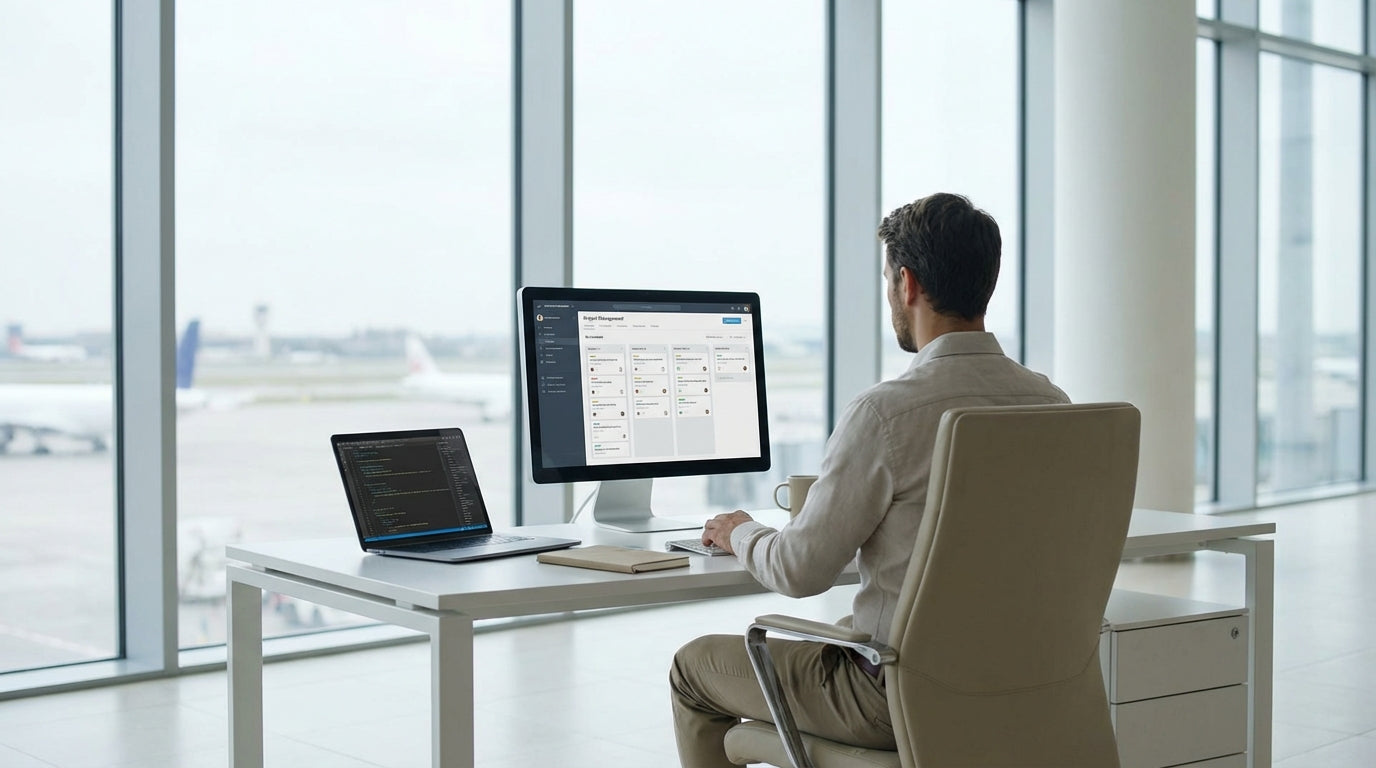
Designing Efficient Back-of-House Airport Offices
Behind every smooth airport experience is a well-organised office hub. These terminal workspaces need to handle constant change, strict security, and tight timelines.
Back-of-house areas support flight operations, security teams, airline managers and customer service coordinators. Planning these spaces starts with understanding how each team works day to day: who needs quiet focus, who needs collaboration, and who needs rapid access to the terminal floor. Compact layouts using Single Person Workstations can help make the most of expensive airport real estate while still keeping staff comfortable.
Desking choices strongly influence how efficiently staff move and communicate. Linear layouts with Straight Desks are ideal for operations and rostering teams that rely on shared screens and constant updates. Where corner space is underused, Corner Office Desks and L-Shaped Desks can create extra surface area for paperwork, devices and reference material without expanding the footprint.
Noise control is another major factor, particularly near baggage halls and security zones. Configurable Partition Workstations help reduce distraction, define walkways, and add a degree of visual privacy in otherwise open areas. When paired with smart cable management and under-desk storage, they create work areas that are both tidy and compliant with safety requirements for clear evacuation routes.
Reception and Check-In Support Areas
First impressions in an airport often start at reception and check-in support desks. These areas must balance branding, security and fast-paced customer service.
Many terminals now add dedicated airline or corporate reception zones away from heavy public traffic. Using Straight Reception Counters works well in narrow corridors or along glass walls, providing a professional front without blocking sightlines. Where a more prominent presence is needed, especially near main entries or internal staff hubs, L-Shaped Reception Counters create a defined welcome point and allow separate zones for check-in queries, staff sign-on and visitor passes.
Behind reception, support staff often manage calls, manifests and last-minute passenger changes. This is where compact desks such as Straight Desks and Corner Office Desks can provide efficient layouts for multiple monitors, phones and printing equipment. Keeping cable paths clear and integrating storage below the worktop reduces clutter, which is important in high-security environments where loose items can become hazards.
Accessibility is essential, both for passengers and staff. Counters should allow space for mobility aids, and integrating height-conscious workpoints with Height Adjustable Workstations can support staff who are on shift for long periods. Adjustable sit-stand solutions let teams alternate between sitting and standing, reducing fatigue and supporting occupational health requirements common in aviation workplaces.
Workstations for Operations, Security and Airline Teams
Operational teams rely on reliable, ergonomic workstations to keep flights running safely and on time. The right mix of layouts supports both focus work and quick coordination.
Airport operations centres, rostering teams and security coordinators often work in 24/7 environments. Providing durable, ergonomic setups such as Height Adjustable Workstations helps reduce strain during long shifts and handovers. These workstations make it easy for staff on different shifts to adjust the desk height to their needs in seconds, which is particularly useful in shared console-style environments with multiple screens.
Where teams need frequent face-to-face discussion but also some separation, modular Partition Workstations are a practical choice. Low or mid-height screens provide enough privacy for sensitive information while allowing line-of-sight communication across the room. Combining these stations with Single Person Workstations at the edges of the office offers quieter spots for staff to complete incident reporting, compliance documentation or planning tasks.
Airline management and duty managers often need more surface area to manage rosters, manuals and portable devices. In these roles, L-Shaped Desks and Corner Office Desks can create clear zones for computers, paperwork and quick stand-up discussions with team leaders. For senior decision-makers within the terminal, dedicated spaces fitted with Manager Desks help separate strategic work from the operational floor while still keeping them close to the action.
Private Focus Areas and Collaborative Pods
Modern terminals need flexible spaces that shift between quiet focus and fast collaboration. Compact, enclosed furniture solutions are ideal where building extra rooms isn’t practical.
Acoustic Office Pods offer semi-private spaces for HR meetings, airline briefings or confidential security discussions right inside the terminal office footprint. Because they are typically modular and self-contained, they can be installed without major building works and relocated as layouts change over time. This flexibility suits airports where tenant mixes, routes and staff numbers can shift quickly.
Pods can be configured as phone booths for private calls, two-person meeting spaces for quick stand-ups, or small multi-seat zones for crew briefings. Positioning them near clusters of Single Person Workstations lets staff quickly duck into a quiet area without leaving the secure zone. Pairing pods with nearby Straight Desks or L-Shaped Desks provides a mix of open workpoints and enclosed spaces that supports different work styles.
Where full pods are not required, carefully arranged Partition Workstations can create semi-enclosed “neighbourhoods” for specialist teams such as baggage services or lost property. Combining these with selected Height Adjustable Workstations helps staff move between quick stand-up problem solving and longer periods of desk-based administration with minimal disruption.
Future-Proofing Terminal Office Furniture Choices
Airports change constantly, so furniture should be able to adapt without major cost or disruption. Planning with flexibility in mind reduces downtime and supports growth.
When selecting desks and workstations, choosing modular, reconfigurable systems makes it easier to respond to airline moves, gate changes or new security requirements. Desking families that include Straight Desks, L-Shaped Desks and Corner Office Desks allow layouts to be reshaped as teams grow or consolidate. This is particularly useful in shared tenant spaces where different airlines, ground handlers and government agencies need to co-exist in the same office zone.
Health and wellbeing expectations among airport staff are also rising. Integrating a baseline of Height Adjustable Workstations across teams signals a commitment to ergonomics and helps manage fatigue in high-pressure roles. Combining these with task-appropriate options like Single Person Workstations for focus work and Office Pods for downtime or quiet calls creates a more sustainable working environment.
Finally, consider how reception and public-facing areas may evolve with new technology and passenger flows. Flexible choices such as modular Straight Reception Counters and L-Shaped Reception Counters can be rebranded, resized or relocated as airlines change or as more self-service technology is introduced. By investing in adaptable furniture solutions from the outset, terminals can support current operations while staying ready for the next phase of aviation growth.


