

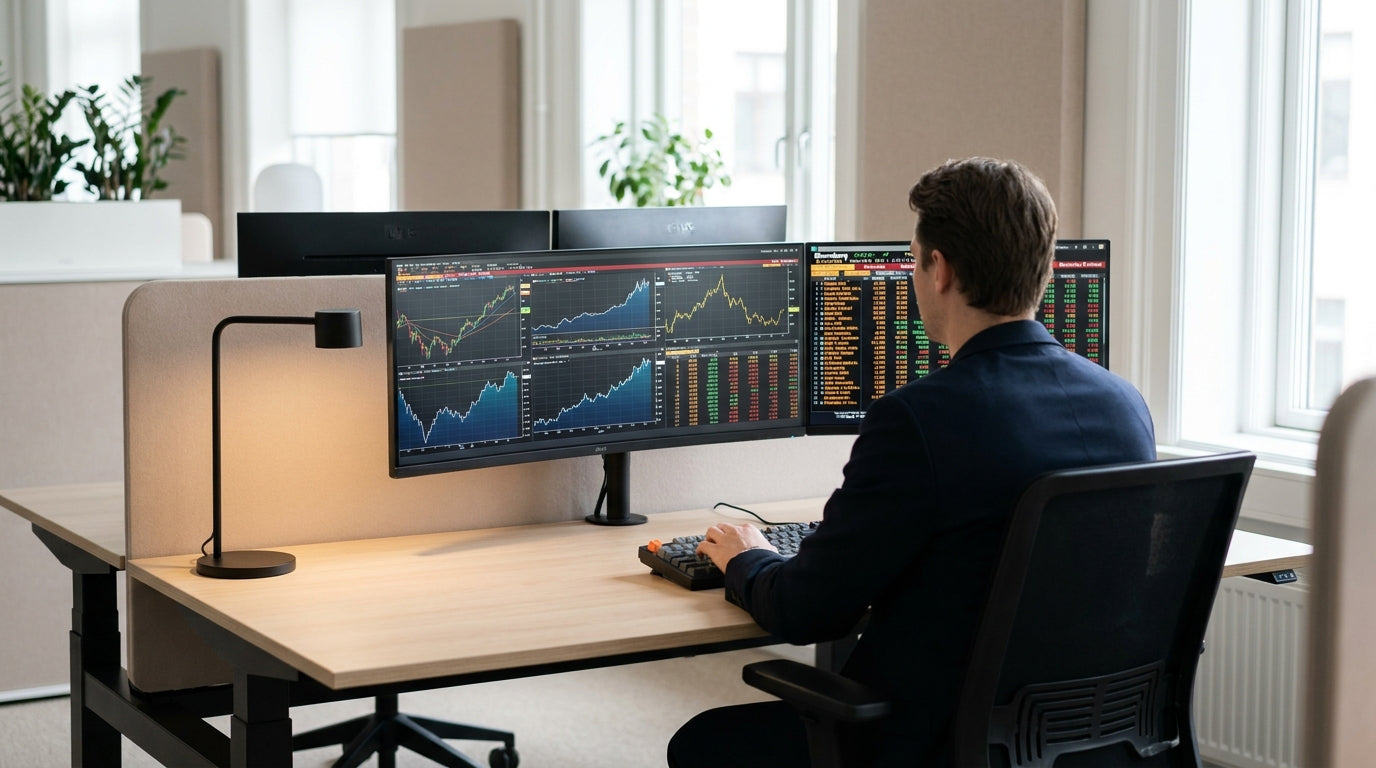
Why Your Trading Desk Layout Matters More Than You Think
A well-planned trading desk is critical for speed, focus, and risk management. When markets move in seconds, a cluttered or uncomfortable setup can cost you real money.
Day trading involves handling multiple charts, news feeds, and order tickets at once. If your monitors, keyboard, and mouse are poorly placed, your eyes and hands travel further than they need to, slowing reaction times. A purpose-built layout brings everything into a tight, efficient “work zone” so you can act quickly and accurately.
Comfort is just as important as speed. Long sessions spent leaning forward or craning your neck add up to serious strain over weeks and months. By choosing the right style of desk, chair, and accessories, you can reduce fatigue and maintain consistent performance through the entire trading day.
It also pays to think about your trading environment at home. Whether you prefer a dedicated room or a compact corner set-up, options like Home Office Desks make it easier to separate “trading mode” from the rest of your life, which helps with discipline and mental reset after the close.
Choosing the Right Desk Shape and Size
The physical shape of your desk defines how easily you can reach your tools. For traders, that usually means prioritising corner or wrap-around layouts.
If you like to sit “inside” your setup with screens on both sides, a corner design works brilliantly. A dedicated trading nook can be built around Corner Office Desks or more system-based Corner Workstations, giving you plenty of depth for multiple monitors and peripherals. These shapes minimise wasted space behind screens and keep everything within easy reach of your chair.
Traders who want a more open, flexible layout often gravitate to an L-shaped option. An L-Shaped Desk allows you to dedicate one side to your main trading screens and the other to note-taking, a laptop, or a secondary strategy. If you prefer something more compact or are trading part-time, streamlined Single Person Workstations can still handle a dual or triple-monitor setup without dominating the room.
Size is mostly about balance: you need enough surface area for monitors, keyboard, mouse, and maybe a notepad, without forcing your arms to stretch. As a rule of thumb, go wider rather than deeper if you use several screens, and consider future upgrades so you do not outgrow your desk as your trading evolves.
Optimising Monitors, Arms, and Cable Management
Screen placement is one of the biggest performance upgrades you can make. The goal is to see everything you need without constantly turning your head.
Instead of relying on the stands that come with your monitors, consider dedicated Monitor Arms. These allow you to fine-tune height, distance, and angle so the top of your main screen sits roughly at eye level and an arm’s length away. You can stack or curve multiple monitors to create a visual “command centre” that matches your trading style, whether that’s two large main charts plus a news feed, or a grid of smaller timeframes.
Good cable control is more than just tidiness. Tangled leads make it harder to swap hardware, add screens, or troubleshoot in a hurry. With purpose-built Cable Management solutions you can route power boards, charger bricks, and data cables under the desk, freeing up space and reducing the risk of knocking something out mid-session. It also makes cleaning easier, which helps keep heat and dust off your equipment.
Once your screens and cables are under control, you can focus on micro-adjustments: keeping your keyboard and mouse centred in front of your main monitor, leaving enough mousing room for fast moves, and ensuring nothing blocks your quick access to hotkeys. These small details add up to smoother, more confident order entry.
Ergonomics: Chair, Posture, and Height Adjustment
Ergonomics is simply about fitting your workspace to your body. For day traders, that means protecting your back, neck, and eyes over long stretches.
Your chair is your foundation, so it’s worth getting one that supports you properly. Breathable Mesh Office Chairs are ideal in Australian conditions, helping you stay cool in warm weather while offering lumbar (lower back) support. If you need more tailored adjustments, look at Task Chairs, which often feature fine-tuned controls for seat depth, back angle, and armrest height so you can keep your shoulders relaxed and feet flat on the floor.
Desk height matters just as much. If you want to alternate between sitting and standing during slower market periods, Height Adjustable Workstations give you that flexibility without reconfiguring your entire setup. Standing for even short blocks can reduce stiffness, keep blood flowing, and sharpen concentration, especially in the afternoon lull.
Eye strain is another silent performance killer. Keep monitors directly in front of you, avoid harsh reflections from windows, and follow a simple “20-20-20” rule: every 20 minutes, look 20 feet (about six metres) away for 20 seconds. Combined with the right desk height and chair setup, this helps you stay focused deep into the trading session.
Designing a Focused, Distraction-Free Trading Environment
Your surroundings should help you think clearly, not compete for your attention. A tidy, intentional space supports discipline and better decisions.
Start by zoning your workspace. Even in a small home office, you can use dedicated Home Office Desks to mark where trading happens and where everything else belongs. Keeping non-trading items off the main surface reduces visual noise and makes it easier to lock into your charts and order flow. If you’re working in a corner of a living area, a compact layout built around Corner Workstations or Corner Office Desks can create a clear psychological boundary.
Lighting and sound also play a big role. Aim for soft, indirect light to avoid glare on your screens, and consider a lamp behind or beside your monitors rather than overhead only. If household noise is an issue, simple steps like a door, a rug, or noise-cancelling headphones can make a big difference to your ability to stay calm during volatile market moves.
Finally, build in a bit of flexibility. An L-shaped setup using L-Shaped Desks or compact Single Person Workstations gives you space for writing, reviewing your trading journal, or planning tomorrow’s session away from your main screens. When your environment supports both focused execution and thoughtful review, you set yourself up for steady improvement rather than short bursts of luck.


