

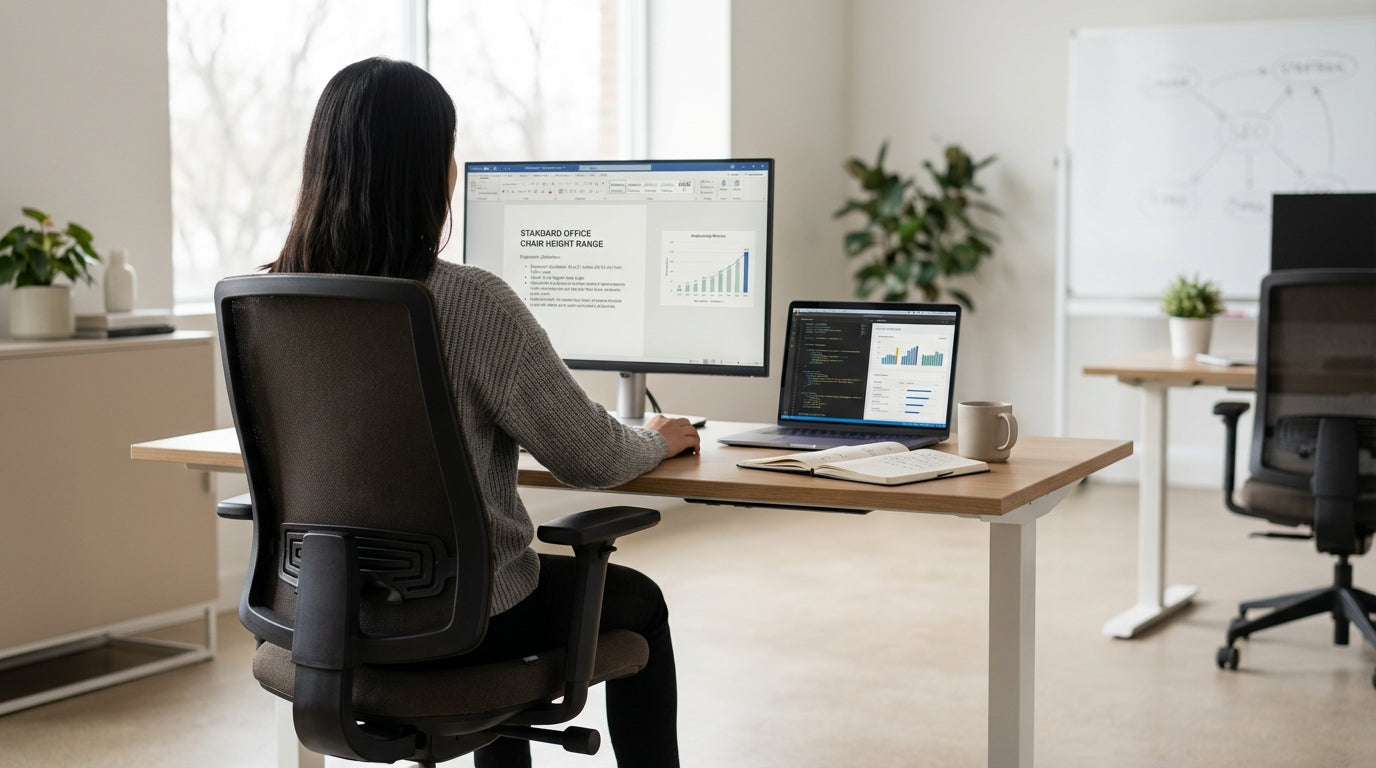
Why Office Chair Height Matters More Than You Think
Getting your office chair height right is one of the simplest ways to improve comfort and reduce fatigue at work. It directly affects posture, circulation, and how your whole body feels by the end of the day.
When a chair is set too high, your feet may dangle or only touch the floor with your toes, which can compress the backs of your thighs and reduce blood flow. Too low, and your knees sit higher than your hips, rounding your lower back and loading extra pressure onto your spine and hip joints. Over a full workday, this can lead to discomfort, stiffness, and sometimes long‑term pain in the neck, shoulders, and lower back.
Height adjustment is especially important in modern hybrid offices, where hot‑desking and shared workstations are common. One person’s perfect setting can be completely wrong for the next, depending on body height, leg length, and even the type of footwear. Adjustable options across different chair styles—from breathable Mesh Office Chairs to versatile Task Chairs—make it much easier for each worker to customise their seating for the day.
A well‑set chair also influences how you interact with your desk, keyboard, and screen. Correct height helps keep wrists neutral while typing, shoulders relaxed, and eyes level with the top of your monitor, all of which are key elements of good office ergonomics. This is why many Australian businesses now treat adjustable seating as a basic workplace health investment, not a luxury.
Typical Height Ranges for Common Office Chairs
Most modern office chairs are built to suit the average adult, but the exact height range can vary by style and purpose. Knowing the usual adjustment span makes it easier to choose a model that fits your body and your workstation.
Standard task and operator chairs in Australia generally offer a seat height adjustment from around 420 mm to 550 mm off the floor. This range is designed for typical desk heights of about 720–750 mm and will comfortably fit many adults between roughly 160 cm and 185 cm tall. If you’re outside that height band—or share a desk with people who are—it is worth checking the full gas‑lift range before buying.
Specialised chairs extend beyond these typical measurements. For higher work surfaces such as drafting tables and counters, Drafting Chairs usually start at about 580 mm and can go up to 800 mm or more, often with a foot ring to support your legs. In contrast, bariatric or Heavy Duty Chairs focus on higher weight ratings and wider seats, though many still maintain a similar height range to standard office models for ergonomic reasons.
In more specialised environments like clinics and laboratories, Lab Chairs & Stools may have taller cylinders and swivel bases to allow easy movement between benches and equipment. These seats often provide fine‑tuned height control to match varying bench heights while still supporting an upright, stable posture. Meeting rooms and reception areas, on the other hand, typically use fixed‑height seating such as Meeting Chairs and Visitor Chairs, where comfort and appearance matter more than frequent adjustment.
How to Measure and Adjust Your Chair Correctly
Setting your office chair correctly starts with a few simple measurements. You do not need specialist tools—just your body, your desk, and a bit of trial and error.
Begin by standing next to your chair and adjusting the seat so that the top is roughly level with the bottom of your kneecap. When you sit down, your feet should rest flat on the floor, with your ankles slightly in front of your knees. Aim for your knees to be close to a 90–100 degree angle and your hips just a little higher than your knees, which helps keep your lower back in a neutral, supportive position.
Next, check your relationship to the desk and keyboard. With your shoulders relaxed and elbows close to your sides, your forearms should be roughly parallel to the floor when resting on the desk or keyboard tray. If you find yourself shrugging your shoulders to reach the surface, the chair is too high; if your wrists are sharply bent upwards, the chair is too low. In some cases, you may need to fine‑tune the desk height as well as the chair to achieve a comfortable match.
Different kinds of chairs will change how you approach adjustment. Height‑adjustable Power Lift Chairs, for instance, use an electric lift mechanism to help you stand and sit more easily, so you will want the seat a little higher than usual when rising. Ergonomically designed Australian Made Chairs often layer additional controls—such as seat tilt and backrest angle—on top of height adjustment, so take time to set each one in a way that supports your natural posture for long periods of work.
Matching Chair Height to Your Workspace and Role
Your ideal chair height depends not just on your body, but also on your daily tasks and work environment. Different roles place different demands on your posture and movement.
For focused computer work at a fixed desk, a well‑adjusted task chair is usually the best choice. A good example is a breathable mesh model, where the flexible back on many Mesh Office Chairs helps you stay cool while the gas lift lets you fine‑tune seat height. If you frequently switch between typing, reading paperwork, and using a phone, look for a design that lets you quickly adjust height and tilt as you change activities throughout the day.
Creative professionals, engineers, and designers who use high workbenches often prefer Drafting Chairs, which pair extra height with foot support. This setup keeps your hips open and spine supported even when working above normal desk level. In laboratories, Lab Chairs & Stools are tailored to frequent movement and easy cleaning, yet still offer enough height variability to align your eyes and hands with instruments and bench‑top equipment.
For shared spaces such as boardrooms and reception areas, the priority is comfort across a wide range of body types rather than detailed adjustability. Fixed‑height Meeting Chairs and Visitor Chairs are therefore designed around average seat heights that work reasonably well for most people. If your organisation hosts longer sessions or full‑day workshops, it can still be worth choosing models with at least some adjustability or pairing them with height‑adjustable tables to better support attendee comfort.
Workplaces that employ larger or taller team members, or roles that demand extended sitting, should also consider Heavy Duty Chairs with reinforced frames and wider adjustment ranges. These chairs often support a more generous seat pan and stronger gas lift, ensuring that seat height remains stable and safe over time. Matching your seating not only to the job, but also to the people doing it, can significantly reduce fatigue and improve productivity across the workday.
Signs Your Chair Height Is Wrong (and When to Upgrade)
Your body usually tells you when something is off with your chair setup. Paying attention to these signals can prevent small annoyances from turning into ongoing issues.
Common signs of incorrect height include numbness or tingling in the legs, pressure behind the knees, and aching in the lower back or shoulders after routine desk work. If your feet do not sit flat without effort, or you find yourself constantly perching on the front edge of the seat, your chair is probably not supporting you properly. Likewise, if you need to hunch your shoulders or bend your wrists sharply to reach the keyboard, it is a sign that chair and desk heights are mismatched.
Some problems can be solved by simple adjustments or adding accessories such as a footrest, but persistent discomfort often points to a chair that is not suited to your body or role. In that case, moving to a more supportive option—such as a quality Task Chair or one of the ergonomically engineered Australian Made Chairs—can make a noticeable difference. For people with mobility challenges, Power Lift Chairs provide extra assistance getting in and out of the seat, further reducing strain on knees and hips.
If you regularly host clients or guests who mention discomfort, it may also be time to reassess the seating in your meeting and waiting areas. Upgrading to supportive Meeting Chairs and well‑designed Visitor Chairs can create a more welcoming, professional impression while quietly taking care of your visitors’ posture. By choosing the right mix—from everyday Mesh Office Chairs through to durable Heavy Duty Chairs—you can set up each workspace with seating that suits both the task and the person using it.


