

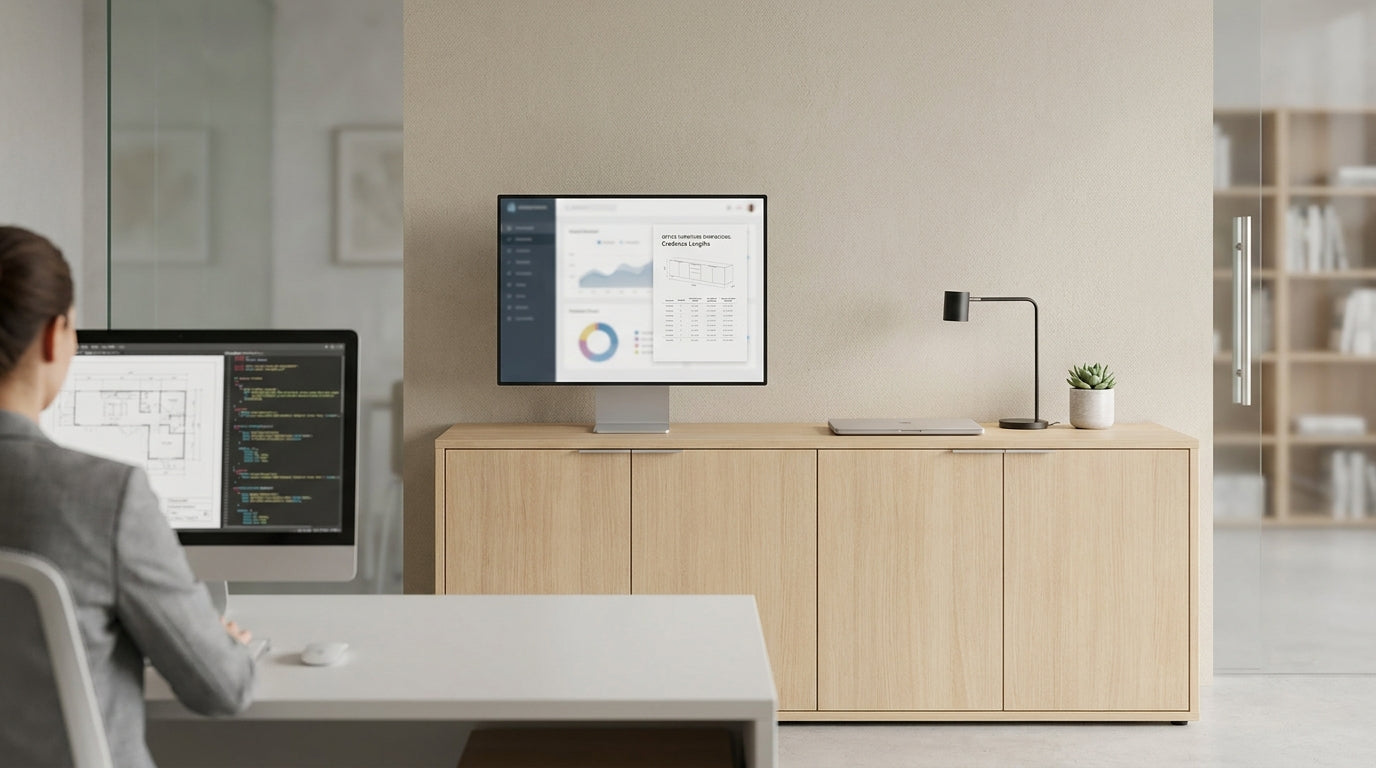
Why Credenza Size Matters in a Modern Office
Choosing the right credenza size can transform how your workspace functions. It affects storage capacity, traffic flow and how tidy your office looks.
In Australian offices, credenzas are used as low storage units that sit behind or beside the main workstation. They often hold files, stationery, printers and personal items that don’t belong on your primary desk. Because they bridge the gap between storage and workspace, getting the proportions right is just as important as choosing the right manager desk or workstation layout.
Unlike tall cupboards, a credenza typically sits at about desk height and runs horizontally along a wall. This makes its length the key dimension you’ll notice in the room. Too short and you lose valuable storage; too long and you crowd walkways or block access to other furniture such as office cupboards or sliding door cabinets.
The right length also depends on how a credenza relates to nearby desks. For executive layouts, pairing a credenza with larger manager desks creates a cohesive, generous workspace. In smaller offices or shared rooms, it needs to sit neatly with compact straight desks or flexible home office desks without overwhelming the area.
Typical Credenza Lengths You’ll See in Australian Offices
Most office credenzas fall into a handful of standard size ranges. These suit common desk widths and typical corporate floorplans.
For smaller offices and home workspaces, compact models around 1200–1500 mm long are common. They provide enough room for files, a printer and some personal storage, while still fitting behind a single workstation or alongside a wall-hugging straight desk. This size is popular where every square metre of floor space counts, such as study nooks or shared spare rooms.
Medium-length units in the 1500–1800 mm range are widely used in open-plan offices and shared rooms. They pair neatly with many L-shaped desks, running along the return or back wall to create a tidy storage zone. This length usually offers 3–4 compartments or doors, which is enough to separate private, team and general supplies without overcomplicating the layout.
Larger executive and boardroom spaces often use credenzas from 1800–2100 mm or more. At this size, they can double as buffet units in meeting rooms, handling catering, AV equipment and document storage. Matching a longer credenza with premium Luxe storage pieces helps create a consistent high-end look across the whole fit-out, especially when finishes and handles are coordinated.
Matching Credenza Length to Your Desk and Layout
The best length is the one that works with your desk size and the way people move through your office. Start by looking at the footprint of your main workstation.
When your desk is the star of the room, the credenza should support it rather than compete. Executive settings that feature substantial manager desks often suit longer credenzas that span close to the width of the desk. This creates a unified “command centre” feel: work surface in front, storage and equipment behind. For smaller home office desks, a shorter credenza keeps the room from feeling cramped and leaves room for extra seating or a small meeting table.
If you use a corner or L-shaped desk, consider how the credenza will interact with the return. A medium-length unit along the wall side can act as an extension of your bench space, especially if it’s similar in height. In shared offices, shorter units placed under or beside straight desks can give each team member personal storage without cluttering the aisle.
Also factor in surrounding storage. If you already rely on vertical solutions like hutch storage units above the desk or larger office cupboards in the room, you may not need an oversized credenza. On the other hand, if you prefer everything low-line for a more open feel, investing in a longer credenza paired with matching credenzas / buffets across the office can replace the need for tall units altogether.
Depth, Height and Storage Configuration to Consider
Length is only one part of getting credenza sizing right. Depth, height and internal layout all affect how useful it will be day to day.
Depth is how far the unit projects from the wall, and it determines both storage capacity and how comfortably people can move past. Common office credenzas are around 450–600 mm deep, which suits A4 and lever-arch files without wasting space. In tight rooms or smaller home studies, pairing a shallower credenza with a compact home office desk can make the area feel less cramped while still providing closed storage.
Height typically aligns with the average desk height so the top can double as a secondary work surface. This is useful next to straight desks or between two workstations, where the credenza can hold shared equipment like printers or label makers. If you already have hutch storage units sitting on a desk, keep the credenza height lower to avoid the space feeling boxed in.
Inside, think about whether you need adjustable shelves, lockable compartments or integrated filing. Some credenzas pair well with other Luxe storage pieces, using the same handles and finishes to keep everything visually consistent. In boardrooms, models similar to credenzas / buffets may feature cable management or open sections for AV gear, while in back offices you might prioritise simple shelving to complement bulkier sliding door cabinets and office cupboards.
Planning Measurements and Choosing the Right Piece
Before you buy, map out your space carefully. A few quick measurements can prevent costly sizing mistakes.
Measure the wall where the credenza will sit, including any power points, windows or door swings that might limit its length. Leave enough clearance for people to walk comfortably between the credenza and any nearby straight desks or L-shaped desks. As a guide, aim for at least 900 mm of walkway space in busy thoroughfares. If the room is small, you may find that a shorter unit combined with vertical options like hutch storage units gives you better usable capacity overall.
Next, list what you need to store: files, tech, stationery, personal items or catering gear. This will help you decide whether you should pair a modest credenza with larger office cupboards, or go for a feature piece that doubles as a focal point alongside high-end Luxe storage. In shared or executive offices, matching finishes between your credenza and manager desks creates a cohesive, professional feel.
If your room doubles as a meeting space or dining area, consider options similar to credenzas / buffets, which are designed to look good while handling functional storage. They can sit behind home office desks in multi-purpose rooms, or along one wall in a boardroom. By balancing length, depth and storage style with the rest of your furniture, you’ll end up with a credenza that earns its footprint every day.


