

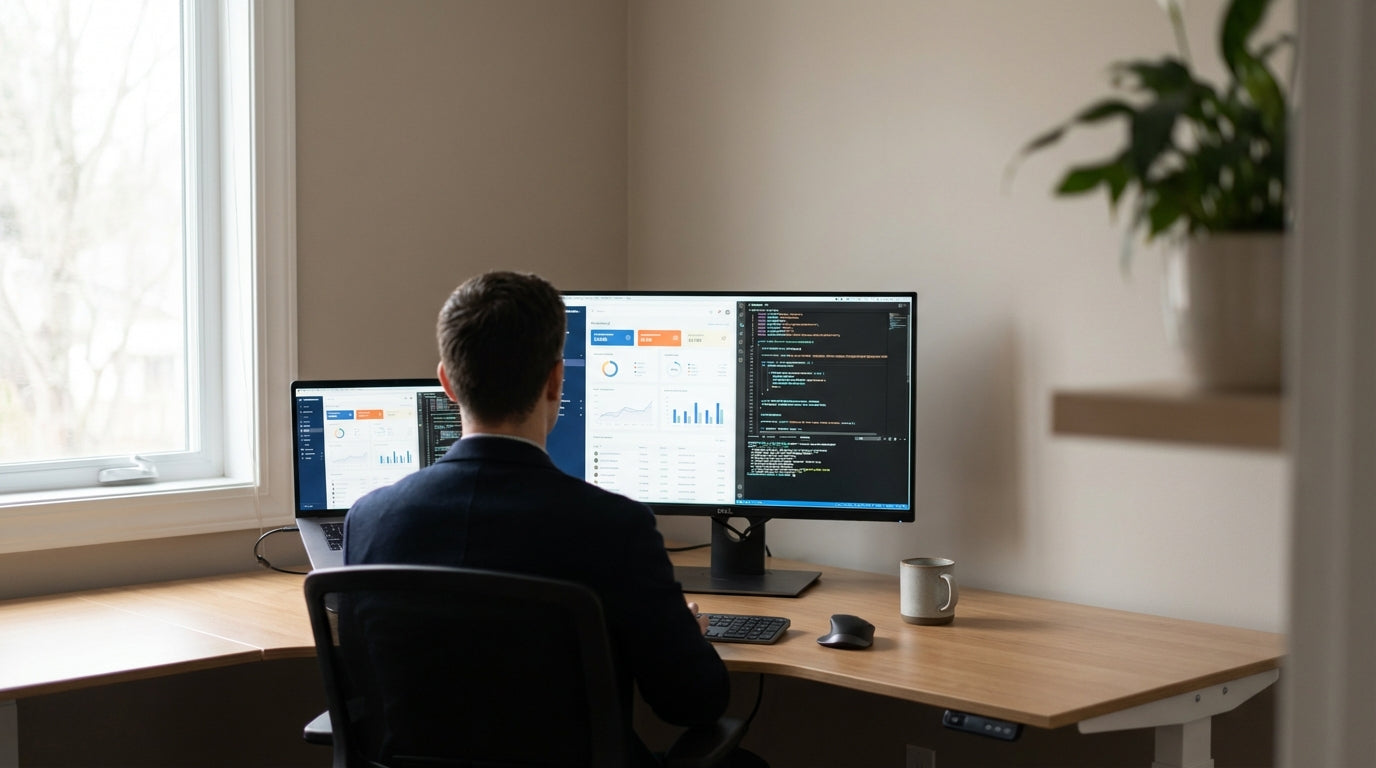
Measuring Your Small Office Before Choosing a Desk
Getting the right corner desk starts with accurate measurements. A few minutes with a tape measure can save you years of frustration.
Begin by measuring the full length of each wall where the desk might sit, from corner to corner. Note the position of power points, windows, doors and any fixed features like heaters or built-in cupboards. These details will affect where your monitor, printer and cable runs can go. It also helps to sketch a quick floor plan with dimensions so you can compare different desk sizes easily.
Next, measure the depth of the room from the wall to any obstruction, such as another piece of furniture or a walkway. For most small offices, you’ll want to maintain at least 900 mm of clear space behind your chair so you can move comfortably. If you are working from home, check whether a door swings into the space where your desk might go, as this can limit how deep a workstation you can choose.
Finally, think vertically as well as horizontally. Measure the height of window sills and existing storage like bookcases or office shelving to ensure they won’t clash with the desk. If you plan to add office cupboards or wall-mounted shelves later, leaving clearance above the desk will keep the area feeling open rather than cramped.
Common Corner Desk Dimensions for Compact Spaces
Most small offices can accommodate a compact corner setup if you pick the right footprint. Understanding standard sizes makes comparing options much easier.
Many corner office desks designed for tight rooms start around 1200 x 1200 mm, which suits basic computer work and light paperwork. If you regularly spread out documents, a 1500 x 1500 mm configuration offers more elbow room without overwhelming the space. Depth is just as important: a 600–700 mm surface depth generally provides enough space for a monitor, keyboard and some accessories while still fitting into a modest room.
For people who prefer extra leg room or need space for a printer, an L-shaped layout can work well. Compact L-shaped desks often pair one longer side (for example, 1500–1800 mm) with a shorter return of 900–1200 mm. This gives you a clear “primary work zone” for the computer and a secondary surface for writing or equipment, which can be ideal in a narrow home office.
Single-user configurations such as single person workstations and smaller corner workstations are typically engineered with space-saving in mind. Their dimensions balance ergonomic depth with slim profiles that don’t dominate a room. When comparing sizes online, always check both the overall width and the length of each side so you know exactly how they’ll sit against your walls.
Balancing Ergonomics with Limited Floor Space
A small office still needs to be comfortable to work in. The right desk size should support healthy posture as well as fit the room.
Ergonomics is about aligning your body so you can work without strain. Aim for a desk height that lets your forearms rest roughly parallel to the floor when typing, with shoulders relaxed. Many fixed-height home office desks are around 720–730 mm high, which suits most people, but if you’re particularly tall or short, consider height adjustable workstations so you can fine-tune the setup.
Desk depth is crucial for eye comfort. You need enough distance between your eyes and the screen—usually about an arm’s length—to reduce eye strain. In a compact room, 600 mm can be sufficient if your monitor is on a slim stand or arm. If you use multiple monitors, you may benefit from a slightly deeper surface or an L-shaped layout so screens can be angled rather than forced too close.
Legroom is another factor often overlooked when trying to squeeze a desk into a corner. Avoid overloading the space beneath with storage or bulky computer towers. Mobile pedestal drawer units can slide under the desk but should leave enough space for your knees and the ability to shift position during the day. A well-sized workstation allows you to move freely, stand up easily and adjust your posture, which offsets some of the limitations of a smaller room.
Smart Storage Choices to Keep a Small Desk Functional
The smaller the desktop, the smarter your storage needs to be. Good organisation allows a compact surface to work as hard as a larger one.
Start by giving everything a defined place so your worktop stays clear. Under-desk pedestal drawer units are ideal for files, stationery and personal items that would otherwise clutter your view. Because they’re mobile, you can shift them to free up legroom or reposition them if you later change your office layout. For bulkier items and archived documents, adding tall office cupboards makes use of vertical space rather than eating into valuable floor area.
Open office shelving above or beside the workstation can also lighten the load on your desk. Place frequently used items at arm’s reach and less-used materials higher up. This approach keeps your main working zone focused on the essentials—keyboard, mouse, notebook—while reference materials sit close by but not in the way.
If you share the room with other household activities, well-planned storage becomes even more important. Combining a compact workstation with tidy shelving and closed cupboards makes it easy to “reset” the space at the end of the day. Whether you’re using a compact corner unit or one of the more generous corner workstations, a little planning prevents a small office from feeling chaotic.
Matching Desk Style to Your Work Habits and Room Layout
Once you know your measurements, think carefully about how you actually work. The best desk for a small office is the one that matches your daily tasks and layout.
If you mostly use a laptop and need flexible space for occasional paperwork, a smaller corner unit or streamlined home office desk may be enough. People who juggle paperwork, reference books and tech gear often benefit from the extra surface area of L-shaped desks, which create clear zones for different tasks. Similarly, purpose-built single person workstations can provide a defined, professional-feeling area even when squeezed into a spare bedroom or study nook.
Think about traffic flow too. In a narrow room, you might place the longer side of the desk along the longest wall to maintain a clear pathway behind your chair. Where possible, keep your primary sitting position facing a solid wall rather than a doorway to reduce distractions. Many modern corner office desks are designed with cable ports and modesty panels that let you place them comfortably in corners or against open spaces while still looking neat from all angles.
If you like to change positions during the day, incorporating height adjustable workstations into a corner layout can give you the benefits of sit-stand work without needing extra room. Pairing a compact adjustable surface with smart storage such as office shelving lets you carve out a comfortable, efficient workspace, even when every centimetre in your small office counts.


