

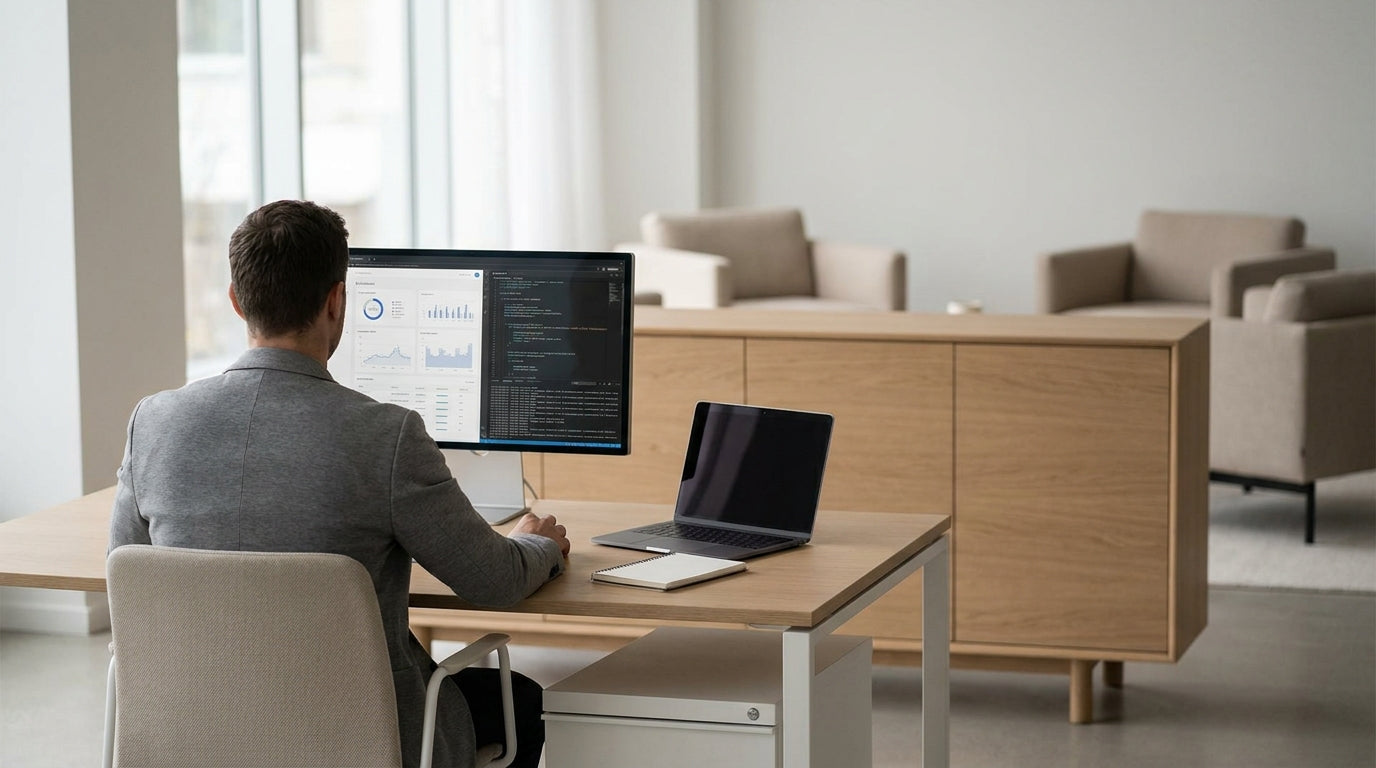
Understanding Credenza Dimensions for Open-Plan Spaces
A credenza can double as a stylish room divider if you choose the right size and proportions. The key is balancing storage, privacy, and safe movement through your office or home workspace.
Most credenzas are between 900 mm and 1200 mm high, which is ideal for visual separation without completely blocking natural light or sightlines. Length typically ranges from 1200 mm to 2100 mm, giving you enough span to carve out zones between Single Person Workstations, seating areas, or a meeting space. Depth usually sits between 450 mm and 600 mm, so it doesn’t intrude too far into walkways while still providing practical storage.
Think of height as your privacy dial. A low credenza around desk height will lightly mark out zones, while taller options up to about 1200 mm create more of a visual barrier, closer to a low wall. If you already use Floor Partitions in your layout, match or complement their height for a consistent look and line across the room.
When using a credenza as a divider in a shared office, consider what you need to store. If the unit will hold files, technology, or bulk stationery, check the internal dimensions against alternatives such as Office Cupboards and Stationery Cupboards. This helps you avoid buying a divider that looks right but falls short on everyday functionality.
Choosing Length and Placement for Flow and Function
Length dictates how effectively your credenza defines different zones. It also affects how people move through the space.
For smaller rooms or home offices, a unit between 1200 mm and 1500 mm often works best, giving definition without overwhelming the area. In larger open-plan offices, you can step up to 1800 mm or 2100 mm to separate clusters of Partition Workstations from collaboration spaces. Always allow at least 900 mm of clear walkway around the ends of the credenza so staff can move freely and meet accessibility expectations.
Placement matters as much as size. Position the credenza so it lines up with existing furniture like desks, Bookcases, and Office Shelving to create neat, logical paths. Avoid setting the unit in the direct swing path of doors or emergency exits, and keep sightlines to reception, exits and any shared equipment clear.
If you’re dividing a workstation cluster from a walkway, measure the full span you need to cover and decide whether one long unit or two shorter units works better. Multiple shorter credenzas can give you flexible “modular” separation that can be reconfigured as the team grows, particularly when paired with mobile Floor Partitions or additional Sliding Door Cabinets for extra storage along the same line.
Height, Sightlines, and Privacy Levels
Height is the main factor that decides how much privacy a credenza provides. It also affects how open or enclosed the room feels.
A low unit around 725–750 mm (typical desk height) works well when you want to keep communication easy across the room. This suits collaborative environments where staff at Single Person Workstations need to see and talk to each other, but still appreciate a subtle boundary. For more privacy, look at pieces in the 900–1200 mm range, which hide seated workers while letting them stand and see over the top when needed.
Think about how the credenza interacts with nearby storage. Taller items like Office Cupboards or high Bookcases can create a solid visual block if placed immediately behind or beside it. In contrast, low shelving or open Office Shelving above desk height keeps the space lighter and less crowded while still offering storage.
In reception or client-facing areas, a mid-height credenza around 1000–1100 mm gives privacy for documents and devices on the worktop, but keeps staff visible and approachable. Pairing this with Floor Partitions near meeting areas is a simple way to achieve different privacy levels within the same open-plan setting, without fully enclosing rooms.
Storage Types, Doors, and Accessibility
The best divider credenza does double duty: it separates zones and solves storage problems. Door style and internal layout influence how effectively it can do both.
Sliding doors are particularly practical in high-traffic walkways, because they don’t swing into corridors. A unit with similar mechanics to dedicated Sliding Door Cabinets allows access from either side, especially if the back panel is finished attractively. This means you can open and close it without blocking people moving around Partition Workstations or meeting tables.
If you choose hinged doors, ensure you leave enough clearance so doors can open fully without hitting nearby Office Cupboards, desks, or Bookcases. Measure the arc of the door swing and avoid designing narrow squeeze points that feel cramped. Shelves inside should be deep enough for folders, tech accessories, or supplies you might otherwise keep in Stationery Cupboards.
Consider how often you will access the contents. For frequently used items, place the credenza on the side of the divider facing the primary work zone, and reserve the “back” for decorative items or lighter storage. In shared offices, combining a credenza with taller Office Shelving or enclosed Office Cupboards nearby creates a complete storage wall that still feels more open than solid built-in walls.
Coordinating Credenzas with Other Zoning Solutions
A credenza rarely works alone; it’s most effective when coordinated with other furniture-based dividers. Plan the whole zone, not just a single piece.
Start by mapping where you need quiet focus areas versus collaboration and traffic routes. Use the credenza to define the edge of focused spaces such as clusters of Single Person Workstations, then add Floor Partitions or acoustic panels where extra noise control is needed. For shared storage between teams, match the finish and height of your credenza with nearby Credenzas / Buffets and Office Shelving to create a visually unified barrier.
In larger layouts, you can build layered zoning. A mid-height credenza might form the first line between circulation and desks, with taller elements such as Office Cupboards or Bookcases behind for extra storage and acoustic softening. For meeting or project spaces, combine a credenza used as AV or document storage with a run of Partition Workstations to define boundaries without a traditional wall.
Finally, think about future flexibility. By choosing standard sizes similar to standalone Sliding Door Cabinets or modular Stationery Cupboards, you can reconfigure your layout as teams grow or work styles change. A well-sized credenza, chosen with these factors in mind, becomes a long-term zoning tool rather than a fixed feature you outgrow in a few years.


