

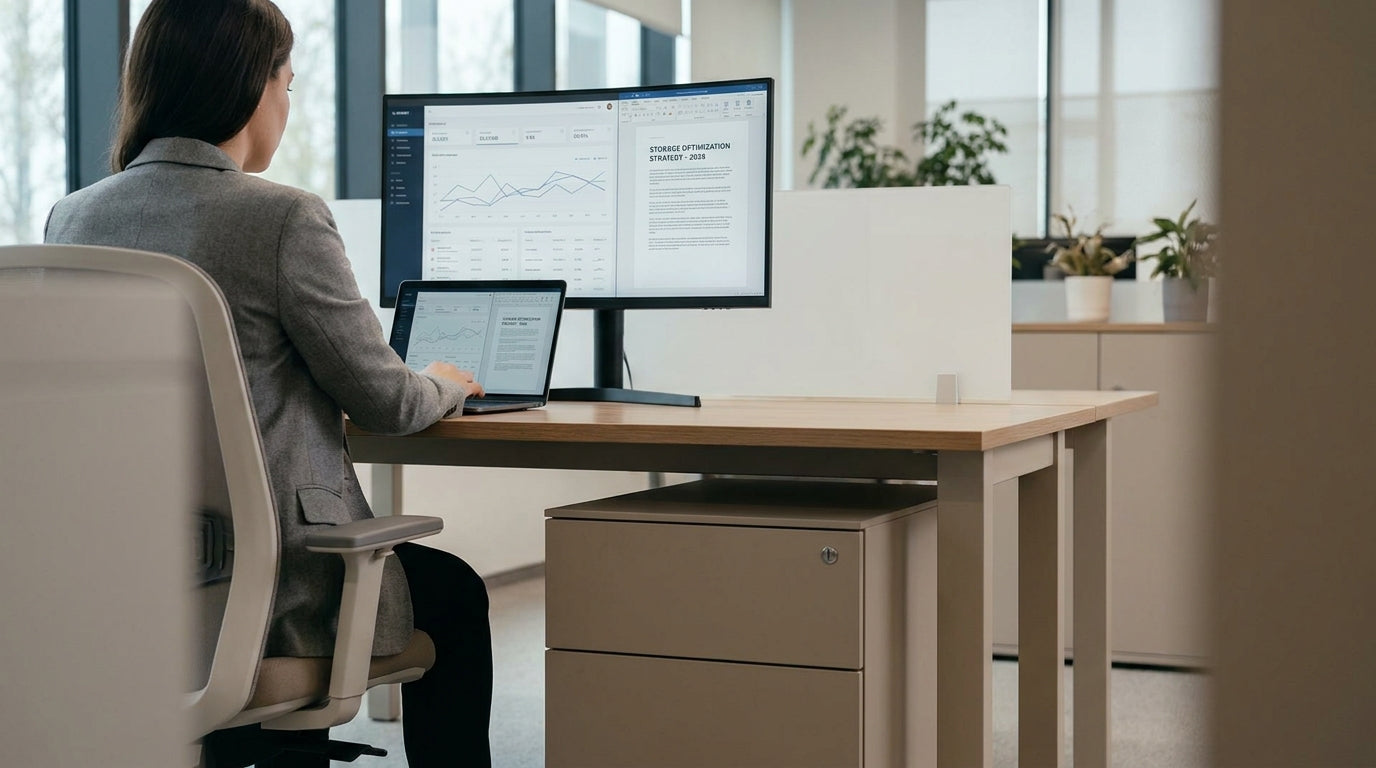
Understanding Deep File Storage Pedestals
Choosing the right pedestal depth is about matching the unit to your files, workspace and workflow. Go too shallow and folders hang out the back; go too deep and you waste floor space.
Deep file storage pedestals are mobile or fixed drawer units that sit beside or under the desk and are designed to take full-depth suspension files. In most Australian offices, that means accommodating A4 or foolscap hanging files front-to-back, not sideways. The key measurement is internal drawer depth, which needs to be long enough for your files plus some clearance so they glide smoothly without catching.
For everyday office use, deep storage pedestals typically sit in the 500–700 mm depth range. Shallower models (around 500–550 mm) suit compact workstations, hot-desking and lighter file loads, while deeper units (600–700 mm) are better when you’re archiving bulk paperwork at the workstation. It’s also worth considering how the pedestal will line up visually and functionally with other storage, such as Filing Cabinets and Office Shelving in your fit-out.
Because pedestals are often moved around, overall footprint matters as much as capacity. A unit that’s technically “deep” but constantly in the way will slow your team down. Balancing depth with height, width and your existing furniture system is the best way to get efficient deep file storage without clutter.
Standard Depth Options and When to Use Them
Most pedestal drawer units fall into a few common depth categories. Each has strengths depending on how you use your files and your floor plan.
Compact pedestals around 500 mm deep work well in tight offices, meeting rooms and shared spaces where floor area is at a premium. They generally hold A4 suspension files, a mix of stationery and personal items, and can tuck fully under a standard desk. If you only need to keep the last few months of paperwork at your elbow, this depth is often enough.
Medium-depth units between 550–620 mm are the workhorses of many Australian workplaces. They suit both A4 and foolscap files, give you a bit of extra room in the file drawer for dividers, and still slide neatly under most workstations. When paired with taller storage like Office Cupboards or Stationery Cupboards, they provide a good balance of local and shared file access.
For heavy-duty deep storage, pedestals in the 650–700 mm range maximise file capacity without stepping up to a full filing cabinet. These units are useful for users who manage large case files, project folders or compliance records and need them close at hand all day. When you start leaning toward this depth, it’s worth comparing capacity and price with dedicated Pedestal Drawer Units ranges and traditional Filing Cabinets to see which is more efficient for your layout.
Matching Pedestal Depth to File Types and Volumes
The right depth depends heavily on what you’re storing and how often you access it. Not all file formats need the same internal space.
A4 suspension files are the most compact option and can fit comfortably in shallower drawers, as long as the rails are positioned correctly. Foolscap files, common in legal and government settings, are longer and demand extra depth to hang cleanly. If you mix box files, binders and lever arch folders with hanging files, you’ll need a deeper drawer to keep everything upright and easy to flip through.
Volume is just as important as format. If your team is largely paperless and only keeps printed copies of key documents, a shallow to medium-depth pedestal is usually sufficient, with bulk records stored in central systems like Comactus units or modular solutions such as Steelco Modular Cabinets. On the other hand, roles that generate daily hard copy—accounting, HR, project administration—benefit from deeper file drawers that prevent overcrowding.
Think about growth as well as current load. A pedestal that fits today’s files exactly will be overstuffed within a year. Choosing a slightly deeper unit gives you room to add folders, dividers and archival sections without compromising access. If your long-term plan is to migrate part of your archive to high-density systems like Premier Storage or lockable GO Steel Storage units, you can size your under-desk pedestals mainly for active files.
Integrating Pedestals with Broader Office Storage
No pedestal sits in isolation; it needs to work with your overall storage strategy. Depth choices should align with your other cabinets and shelves.
Under-desk pedestals usually handle “active” files that staff use daily or weekly, while bulk archives move into larger systems. Full-height Office Cupboards, sliding-door Tambour Cupboards and open Office Shelving can then store boxed files, manuals and reference material. By defining what lives at the desk versus in shared zones, you can determine whether your pedestal needs maximum depth or just moderate capacity.
Security and compliance also influence depth and configuration. Lockable drawer units are ideal for sensitive folders that must stay at the user’s workstation, where building access controls aren’t enough. When these documents are bulky—contracts, medical files or personnel records—a deeper pedestal drawer becomes essential. In high-security areas, pairing deep pedestals with lockable metal systems such as GO Steel Storage or high-density Comactus units ensures both convenience and protection.
A cohesive storage plan also improves the look and function of your office. Matching the depth of your pedestal units with nearby Pedestal Drawer Units, Premier Storage and Steelco Modular Cabinets can create clean sightlines and eliminate awkward overhangs. This helps circulation around workstations and reduces trip hazards, especially where multiple mobile pedestals share the same zone.
Practical Tips for Selecting the Right Pedestal
A quick measure and a short audit of your files will usually point you to the right depth. A few simple checks can prevent costly missteps.
Start by measuring under-desk clearance: height to the underside, available depth from the front edge to any cable tray or modesty panel, and usable width beside chair space. This tells you the maximum pedestal dimensions that will fit without hitting legs or cables. From there, line up your options from compact to deep, and consider how much of the internal space will be used for hanging files versus stationery and tech accessories.
If you’re upgrading multiple workstations, standardising on one or two depths across your Pedestal Drawer Units and matching Filing Cabinets simplifies moves and reconfigurations. Use deeper shared units—such as Office Cupboards, Stationery Cupboards and Tambour Cupboards—for overflow and long-term records so desks don’t become mini-archives. Where floor space allows, supplement pedestals with centralised systems like Comactus or modular metal options from GO Steel Storage, Premier Storage or Steelco Modular Cabinets to keep deep file storage efficient and easy to manage over time.


