

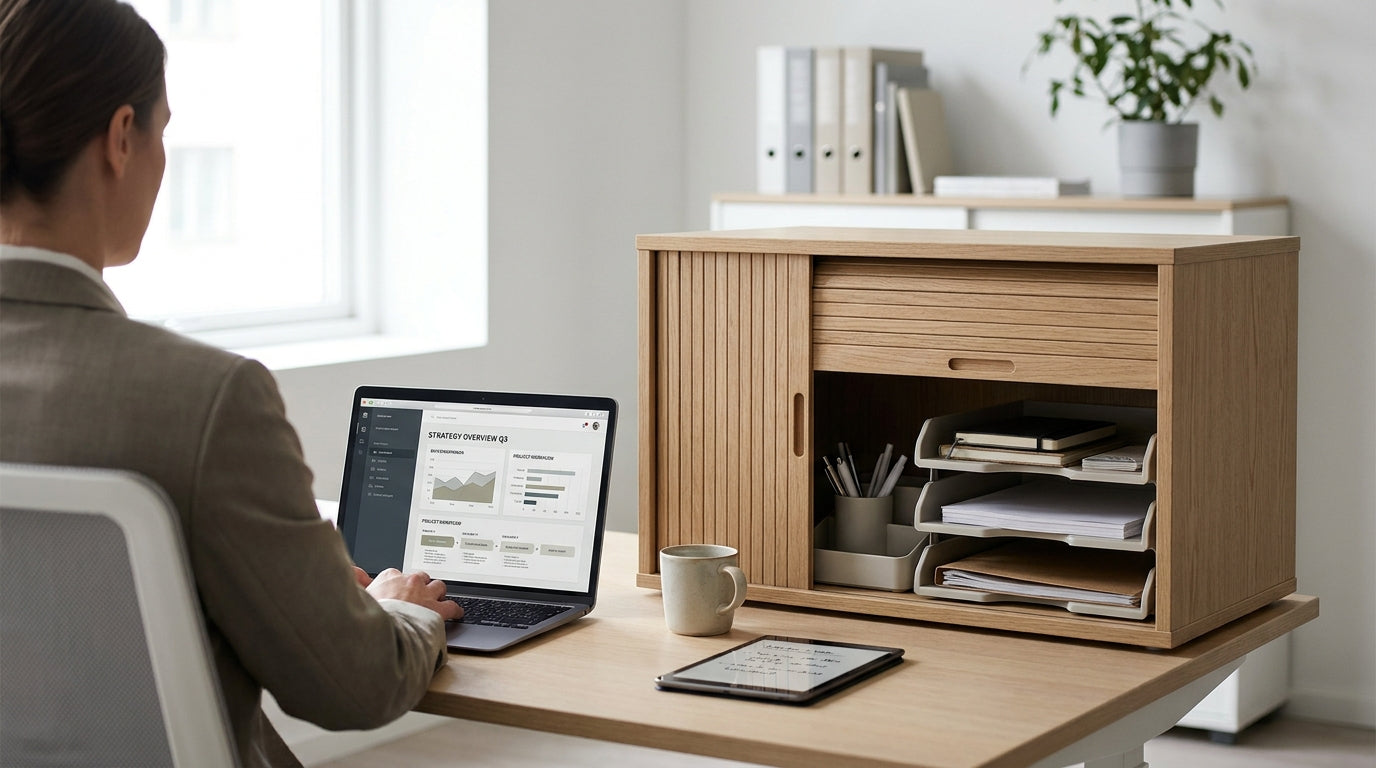
Understanding tambour cabinet sizing for office stationery
Choosing the right tambour unit size starts with knowing what you actually store day‑to‑day. Pens, files, boxes of paper and tech accessories all demand different depths and heights.
Tambour cabinets use rolling doors that slide into the carcass instead of swinging out like traditional Stationery Cupboards. This makes them ideal for tight corridors, compact workstations and shared resource areas where access space is limited. Standard heights range from low units that sit under windowsills to tall cupboards that can replace a full bookcase. Widths are usually designed to match common workstation and storage footprints so they line up neatly with Office Cupboards and similar units.
When planning capacity, think in terms of “levels of storage” rather than overall height. Each shelf or pull‑out frame is one level that can hold files, reams of paper or tubs of stationery. A compact tambour with two or three levels might be enough for a small team, while a tall cabinet with five or more levels suits busy print rooms and shared stationery hubs.
Also consider how you want staff to access supplies. Frequently used items should sit between hip and eye level to minimise bending and stretching. Bulk cartons or archive material can live on the very top or bottom shelves, especially if you supplement the space with nearby Office Shelving for overflow stock.
Measuring your stationery and space before you buy
A quick stocktake will prevent you from buying storage that’s either too small or needlessly huge. Measure both your stationery and the physical space available.
Start by grouping what you store most: A4 lever arch files, manila folders, printer paper, envelopes, labels, spare tech gear and cleaning or kitchen consumables. Stack each category and measure the total height and width. This tells you how many shelves or pull‑out accessories you’ll actually need. Many tambour ranges, such as Steelco Modular Cabinets and GO Steel Storage, allow you to re‑position shelves later, so you can fine‑tune spacing after installation.
Next, measure the floor area and wall space where the unit will sit. Depth is often overlooked: make sure there’s enough clearance so the cabinet doesn’t protrude into walkways or interfere with chairs and doors. Because the doors roll away, tambour units are more forgiving than swinging‑door cupboards, but they still need space for users to stand and access contents.
In open‑plan offices, a medium‑height unit can double as a divider between work zones. For example, pairing a mid‑height tambour with nearby Pedestal Drawer Units gives each pod of desks personal storage plus shared stationery access. For smaller rooms or home offices, slimline designs can be balanced with wall‑mounted Small Storage & Organisers to avoid overcrowding the floor area.
Common tambour cabinet sizes and their best uses
Different heights and widths suit different ways of working. Match the cabinet size to how often items are accessed and who uses them.
Low tambour cupboards (around desk or credenza height) are perfect beside workstations or under windows. They keep frequently used stationery, printer cartridges and files close at hand without blocking sightlines across the office. These compact units also pair well with other low Office Cupboards for a consistent run of storage and bench space. You can keep small items under control using inserts and trays from the Small Storage & Organisers range.
Mid‑height cabinets offer a balance between capacity and accessibility. They typically provide three to four levels of storage, ideal for central stationery points in team areas. Staff can easily see and reach most shelves without steps, which reduces time spent hunting for items. These are often chosen instead of tall traditional Stationery Cupboards when you want to keep the space feeling open.
Full‑height tambour cupboards maximise vertical space, similar to bookcases or tall Tambour Cupboards in print and records rooms. They’re best when you have a high volume of consumables, bulk paper, archival files or mixed office supplies. To avoid clutter, use the lower shelves for heavier cartons and keep the middle shelves for everyday stationery. Ranges such as Premier Storage and GO Steel Storage often include matching tall units so you can maintain a consistent look throughout the office.
Balancing capacity, ergonomics and office layout
Storage isn’t just about fitting everything in; it must also work smoothly in your layout. A well‑chosen cabinet size can improve traffic flow and productivity.
Think about how many people will use the unit at once. In high‑traffic areas, a wider tambour cabinet may be better than a very deep one, allowing two people to access supplies side‑by‑side. If pairing it with neighbouring Office Shelving or Office Cupboards, aim for similar depths so nothing appears to jut out awkwardly into the walkway. Visual continuity helps the office feel organised and intentional, even when multiple storage products are used.
Ergonomics matter for both comfort and safety. Avoid relying heavily on the very top shelf of tall units for items you need every day; a mid‑height tambour or complementary Premier Storage unit at a lower height may be more practical. Smaller consumables can be decanted into labelled trays or tubs that slide in and out, similar to the way Pedestal Drawer Units organise stationery at the desk level. This creates a simple “grab and go” system instead of rummaging through loose items.
Finally, consider how your storage will scale as your team grows. If you anticipate adding more staff or devices, leave wall space to extend your bank of Tambour Cupboards or mix in compatible Steelco Modular Cabinets. Planning for expansion now prevents a patchwork of mismatched units later and keeps stationery management streamlined.
Choosing complementary storage to keep stationery under control
A tambour cabinet works best as part of a broader storage plan. Combining different unit types helps keep clutter in check.
Use tambour cupboards for shared and bulk items, then support them with individual storage at each workstation. Desk‑high Pedestal Drawer Units are ideal for employees’ personal stationery, notebooks and valuables, reducing the load on central cupboards. Wall‑mounted racks and compact bins from the Small Storage & Organisers collection can hold smaller consumables that would otherwise disappear at the back of shelves. This layered approach keeps core stock visible and accessible while preventing every small item from ending up in the same cabinet.
For larger offices, mix tambour units with open Office Shelving and lockable Stationery Cupboards. Open shelves are great for high‑turnover items like copy paper, while lockable cupboards protect expensive tech accessories and branded collateral. Systems such as GO Steel Storage, Premier Storage and Steelco Modular Cabinets often include matching tambour, swing‑door and open units, allowing you to build a cohesive, flexible solution.
By carefully sizing your tambour cabinet and pairing it with the right mix of additional storage, you’ll minimise mess, speed up restocking and create a tidier, more efficient workspace for everyone who relies on office stationery.


