

Why the Frame Matters More Than You Think
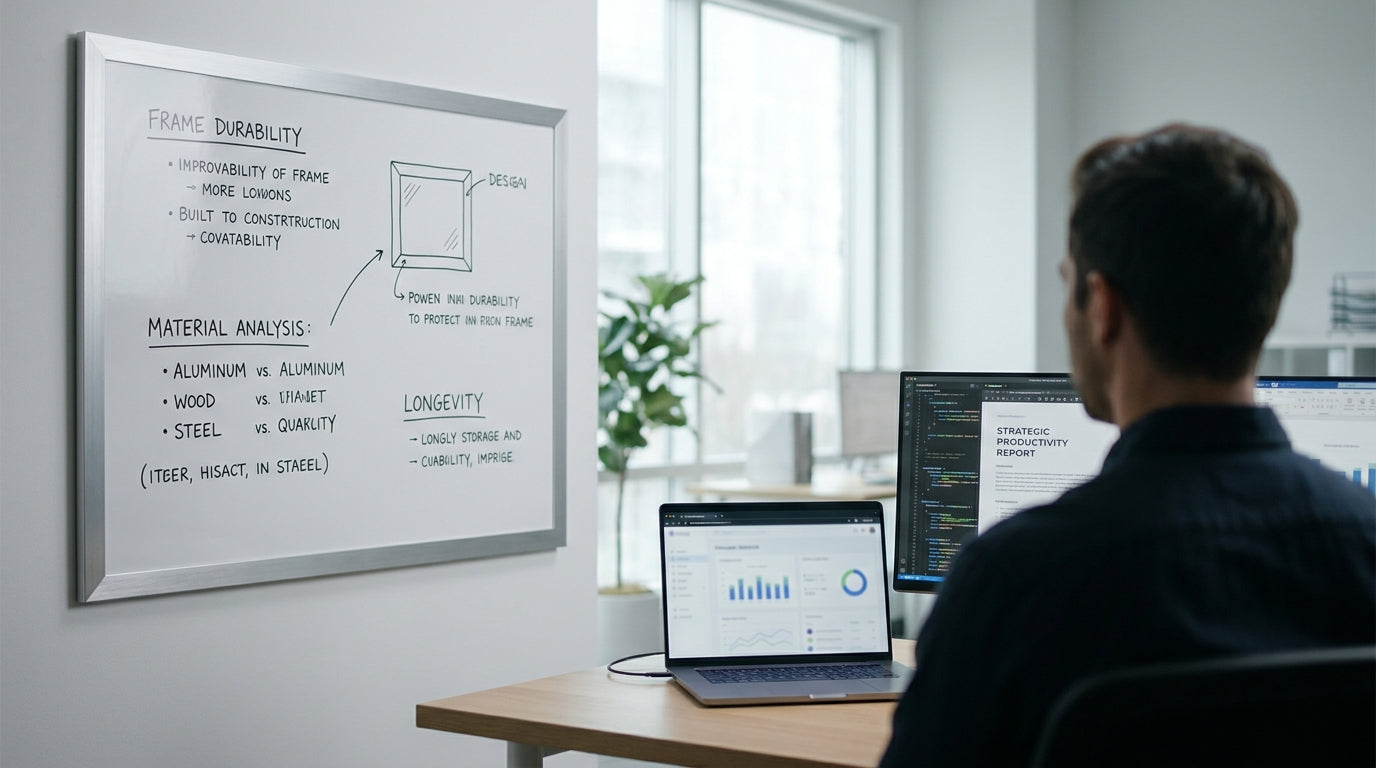
The surface of a whiteboard gets all the attention, but the frame does the hard work. It keeps the board rigid, protects the edges and largely determines how long the whole unit will last.
In classrooms, meeting rooms and busy site offices, whiteboards are bumped, moved and leaned on every day. A strong frame prevents warping, bowing and separating from the wall, helping your board stay flat and easy to write on. When you’re comparing magnetic whiteboards, porcelain whiteboards or even glass whiteboards, the frame design often explains why two similar‑looking boards can have completely different lifespans and price points.
For schools, training centres and healthcare facilities, durability isn’t just about saving money; it’s also a safety issue. A solid frame resists twisting when people push against it or when whiteboard accessories like heavy magnetic organisers are added. By understanding the pros and cons of different frame materials, you can pick a board that survives constant use instead of needing replacement every couple of years.
Aluminium Frames: The Workhorse Option
Aluminium frames are the most common choice in offices and schools. They strike a good balance between durability, weight and cost.
Aluminium is naturally corrosion‑resistant, so it won’t rust in humid environments or coastal areas. Quality models use thicker, anodised aluminium (a hardening process) that resists dents and scratches better than raw metal. This is especially important on mobile whiteboards, which are moved through doorways and corridors where knocks are inevitable.
Because aluminium is light, it’s ideal for larger wall‑mounted boards and magnetic whiteboards that may need occasional repositioning. The lighter frame puts less strain on fixings and plasterboard walls, reducing the risk of sagging corners over time. Many premium planner & specialty whiteboards also use aluminium frames with integrated pen trays or corner caps for added impact protection.
Look for frames with securely mitred (angled) corners and internal corner braces. These hidden supports help prevent racking, where the board gradually twists out of square. On heavy‑duty mobile partitions that include writable surfaces, reinforced aluminium framing around the panel ensures the unit stays stable even when frequently wheeled between rooms.
Steel and Hybrid Frames: When Strength Comes First
Steel frames prioritise strength and rigidity. They are less common in standard office boards but valuable in demanding environments.
Compared with aluminium, steel frames are heavier and more impact‑resistant, making them suitable for industrial sites, workshops and high‑traffic public areas. When paired with a hard‑wearing surface such as porcelain whiteboards, you get a writing surface and frame combination that can handle daily rough treatment. Many heavy framed boards are also magnetic, allowing extra use of whiteboard accessories like magnetic clips, charts and erasers without stressing the panel.
Hybrid frames combine a steel or internal metal sub‑frame with an external aluminium trim. This gives you the cleaner look and lightweight feel of aluminium, supported by the internal strength of steel. You’ll often see this configuration in larger format boards, projection‑capable panels and some projection boards & presentation accessories, where absolute flatness is vital for clear images and legible text.
On electric interactive whiteboards, a rigid hybrid frame helps protect the internal electronics and touch sensors. If the frame flexes or warps, calibration can drift and touch accuracy suffers. For this reason, manufacturers of interactive panels often specify reinforced mounting systems that tie the frame securely into wall studs or mobile trolleys.
Frameless and Glass Boards: Style Versus Sturdiness
Frameless boards and glass panels appeal for their clean, modern look. Their durability depends more on the panel itself and the fixing system than on a traditional frame.
Glass whiteboards are usually made from tempered (toughened) safety glass, which is several times stronger than standard glass. While they don’t have a visible frame, they rely on robust mounting hardware that effectively acts as a hidden frame, keeping the panel from flexing or working loose. The writing surface is extremely scratch‑resistant and won’t stain, making these boards a long‑term option for boardrooms and design studios.
Frameless ceramic or porcelain panels work in a similar way, especially when used as multi‑panel walls in collaboration spaces. The joints between panels and the backing substrate provide the structural support instead of a traditional edge frame. When specified correctly, these installations are just as durable as framed magnetic whiteboards and often more resistant to surface damage.
If you prefer a slim or frameless look on a mobile solution, consider trolleys and stands designed for mobile whiteboards or mobile partitions. In these products, the frame is built into the support structure rather than the edge of the panel, giving you a minimalist appearance without sacrificing strength or stability.
Choosing the Right Frame for Your Space
The most durable option for you depends on how and where the whiteboard will be used. Match the frame material and construction to the demands of your environment.
For busy classrooms, training rooms and general office use, an anodised aluminium frame around a hard‑wearing surface like porcelain is usually ideal. It’s light enough for easy installation yet strong enough to resist everyday bumps. Adding compatible whiteboard accessories such as magnetic erasers, markers and organisers helps you get more value from the board without overloading the frame.
In industrial settings, workshops or high‑traffic corridors, look for steel or hybrid frames with reinforced corners and solid wall fixings. Pair these with porcelain whiteboards or durable planner & specialty whiteboards designed for heavy daily use. Where layout changes frequently, robust mobile whiteboards and mobile partitions give you flexibility while still providing strong framing around the panel.
For client‑facing spaces, boardrooms and presentation areas, slim aluminium or frameless glass options can deliver a sleek aesthetic without compromising longevity. Consider integrating projection boards & presentation accessories or upgrading to electric interactive whiteboards where digital collaboration is important. In every case, check the frame thickness, corner construction and mounting hardware—these details ultimately decide how long your whiteboard will stay straight, safe and easy to use.


