

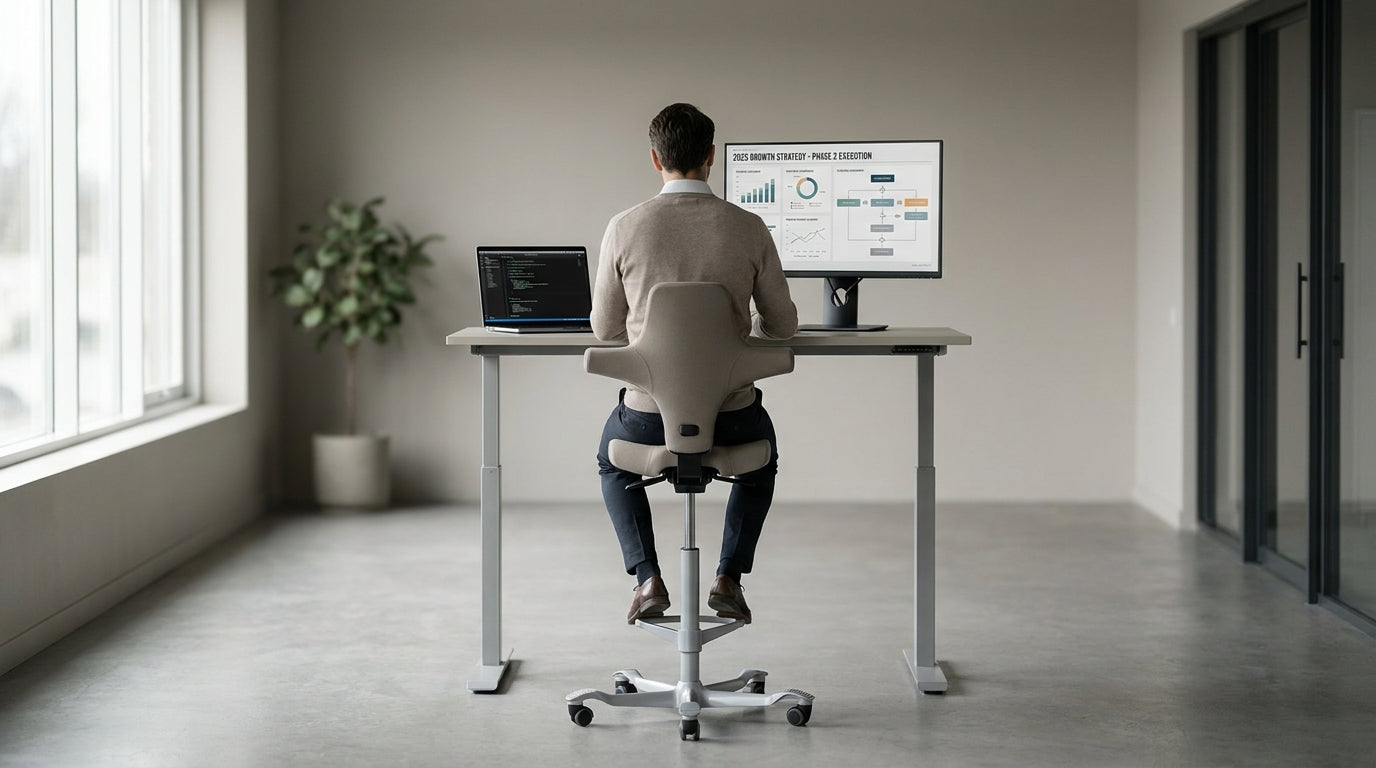
What Is Perching Posture and Why It Matters
Perching sits between sitting and standing, letting you rest your weight while staying upright and active. It’s ideal for height-adjustable desks and anyone who feels stiff or sluggish in a traditional chair.
Instead of a 90-degree angle at your hips and knees, perching usually means your hips are higher than your knees and your torso is slightly forward. This opens the hip joint, encourages a natural curve in your lower back and makes it easier to engage your core muscles. In practical terms, it feels more like leaning on your chair than sinking into it.
Australian office workers who use standing desks, dual workstations or collaborative spaces often benefit from this set-up. By moving between sitting, perching and standing, you reduce static load on your spine and avoid that “slumped at 3 pm” feeling. The right seating makes these transitions quick and comfortable.
Perching-style seating can be found across several categories, including specialised Drafting Chairs, ergonomic Task Chairs with higher gas lifts, and adjustable stools commonly used in labs and studios. Understanding these options helps you choose a seat that suits both your body and your workspace.
Key Features to Look For in a Perch-Friendly Chair
A good perch-ready chair needs more than just extra height. It should actively support a forward-leaning, open-hip posture without putting pressure on your knees or lower back.
Height range is the first non‑negotiable. Look for a gas lift that can comfortably reach your sit-stand desk height so you can rest your pelvis on the seat while your feet stay securely on the floor or a foot ring. Many Drafting Chairs are engineered for this, offering extended cylinders and stable bases to handle higher working positions.
Seat design also plays a big role. A waterfall edge (a rounded front) reduces pressure behind the knees when you’re perched forward. Firmer foam or contoured seats help keep your pelvis stable so you don’t slide off as you lean. Some Lab Chairs & Stools use saddle-style seats that naturally tilt your pelvis into a neutral position, which can be particularly comfortable for longer perching sessions.
Back support and materials matter, even if you perch more than you fully sit. Breathable options such as Mesh Office Chairs can prevent heat build-up and provide flexible lumbar support as you move. If you’re on the heavier side or using your chair for extended hours, look for models classed as Heavy Duty Chairs, as these are designed with stronger components and wider bases for stability at taller heights.
Best Chair Types for Sit-Stand and Hybrid Workstations
If you’re moving between sitting and standing throughout the day, some chair designs work far better than others. Matching the chair type to your desk height and tasks is essential.
For standard-height desks that occasionally go higher, ergonomic Task Chairs with a mid-to-high gas lift can be enough. Many task models include seat tilt, allowing you to angle the seat slightly forward to support a perching stance. Pair this with adjustable lumbar support and you can maintain a healthy spinal curve in both traditional sitting and semi-standing positions.
For taller benches, drafting tables or full sit-stand desks, specialised Drafting Chairs are often the best match. These usually feature a foot ring so your feet have a solid base when your hips are raised higher. The ring prevents you from dangling your legs, which can strain your lower back and hamstrings over time.
In more flexible or collaborative environments, designers often mix perch-friendly stools with conventional seating. High Bar Stools can provide quick lean support around standing-height tables, while stackable Training Chairs and Meeting Chairs cater to people who prefer a lower, more traditional sit. This hybrid approach gives everyone in the team options that suit their bodies and work styles.
How to Set Up Your Chair for a Healthy Perch
Even the best chair won’t help if it’s not adjusted correctly. A few simple tweaks can turn an ordinary workday into a far more comfortable one.
Start with height. When perched, your hips should sit slightly higher than your knees, with your feet flat on the floor or a supported surface like a foot ring. If you’re using higher stools or Bar Stools, make sure you can still keep a stable base through your feet rather than resting only on the seat edge. Your elbows should roughly line up with your desk surface so your shoulders can relax.
Next, fine-tune the seat angle and backrest. If your chair allows seat tilt, a slight forward angle can encourage an upright torso without forcing you to arch. Keep lumbar support (the curve in the backrest) sitting in the small of your back, even when you lean slightly forward. Some Mesh Office Chairs and ergonomic Task Chairs have dynamic backs that move with you, which is ideal for alternating between perching and leaning back to rest.
Finally, consider how you move through your day. Rotate between perching, sitting fully back and occasional standing to prevent any single posture from dominating. In shared spaces where different people use the same seating, such as with Visitor Chairs or Meeting Chairs, take 30 seconds at the start of each session to adjust height and depth to your own proportions. Small, regular adjustments are more effective than one perfect set-up you never revisit.
Choosing the Right Chair for Your Space and Workstyle
Perching-friendly seating needs to fit not just your body, but also your tasks and environment. Think about how and where you work before you buy.
For home offices and private workstations, investing in a versatile ergonomic model is usually best. Look for adjustable Australian Made Chairs that support both traditional sitting and perching; local manufacturing often means better access to spare parts and tailored configurations. If you also host clients or guests, pairing your main seat with comfortable Visitor Chairs can keep your set-up cohesive without sacrificing ergonomics.
Studios, clinics and labs often need higher, more mobile seating. Here, specialised Lab Chairs & Stools offer wipeable surfaces, easy height changes and a compact footprint, making them ideal when you’re moving between benches, equipment and computers. For training rooms or hot-desking spaces, lightweight Training Chairs and stackable Meeting Chairs can be mixed with a few taller stools to accommodate users who prefer a higher perch.
Heavier users, or those in 24/7 environments such as control rooms, should prioritise durability and weight rating. Choosing from the range of Heavy Duty Chairs ensures components are engineered for greater loads and continuous use, which is especially important when the gas lift is extended for taller seating. By matching chair type, adjustability and build quality to your daily work, you can enjoy the benefits of an active perching posture without compromising comfort or safety.


