

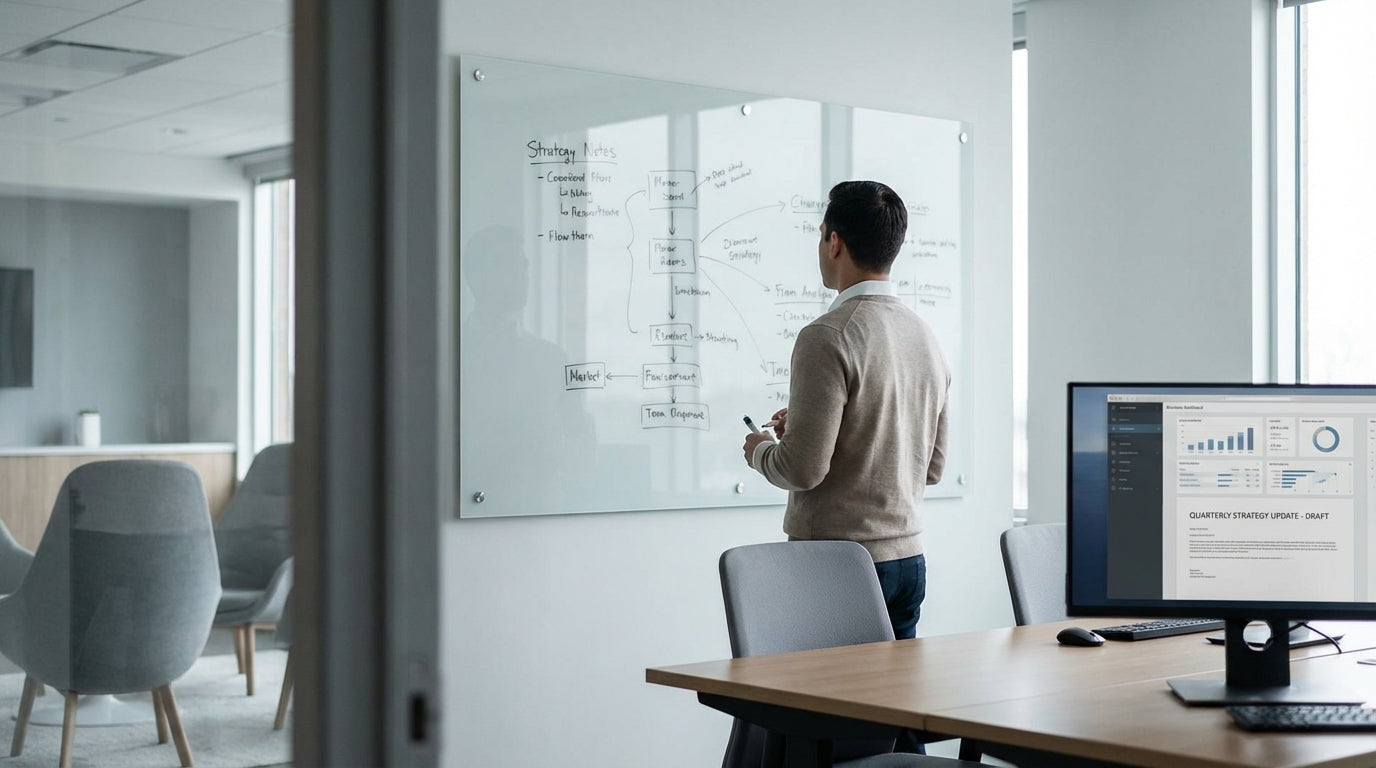
Understanding Glass Whiteboards in Modern Workspaces
Glass boards have become a staple in contemporary offices, offering a sleek alternative to traditional writing surfaces. They combine practicality with a minimalist aesthetic that suits open-plan and hybrid workplaces.
Unlike older melamine or basic enamel surfaces, glass panels use tempered safety glass, which is heat-treated for strength. This makes them far more scratch-resistant, ghosting-resistant (no lingering marker stains) and durable under heavy daily use. For teams that brainstorm frequently or run regular stand-ups, that reliability is a major advantage.
In modern meeting rooms, glass walls and frameless boards can double as both design features and collaboration tools. When paired with the right whiteboard accessories, such as quality markers, erasers and magnetic kits, they support agile workflows without cluttering the space. Their reflective, high-end look also pairs neatly with contemporary office & meeting tables and modular layouts.
Many workplaces are also moving from projectors and flipcharts to mixed visual tools, including electric interactive whiteboards and glass panels used side by side. This blend lets teams shift quickly between digital content and freehand sketching, supporting both structured presentations and spontaneous ideas.
Key Features to Compare Before You Buy
Not all glass boards are the same, so it pays to compare specific features before installing them across your office. Size, finish, and functionality all influence everyday usability.
Firstly, consider whether you need a magnetic surface. Some glass whiteboards integrate a steel backing so you can use strong rare-earth magnets to pin up documents, plans or mood boards. If your team relies heavily on printed charts or agile cards, this will be far more versatile than a non-magnetic board. Non-magnetic versions can still be ideal for minimalist spaces where you only need writing and drawing.
Next, look at glass thickness and edge style. Thicker tempered glass offers a more solid writing experience, with less vibration on the wall and a premium feel. Polished, bevelled or rounded edges all influence both safety and visual impact, particularly in client-facing areas or around boardroom tables. Frameless designs with hidden fixings give a floating effect that feels more architectural than a framed standard board.
Finish matters for readability. Clear, low-iron glass produces a crisp white or coloured backing with strong contrast, which is crucial in long rooms or training spaces. If you often present from the board while others view from the back of the room, compare how different marker colours show up under your actual lighting. In technology-heavy rooms with projection boards & presentation accessories, a matte or low-reflective surface can help reduce glare.
Matching Glass Boards to Different Office Areas
The best panel for a boardroom may not suit a breakout zone or hot-desking hub. Match board type and size to how each area is actually used day to day.
In formal meeting rooms and executive spaces, large wall-mounted glass boards work well alongside quality boardroom tables. They offer a polished backdrop for client presentations, strategy sessions and workshops. To support more structured planning, you might supplement a main glass wall with dedicated planner & specialty whiteboards for calendars, project timelines or sales pipelines.
Open-plan offices and agile zones often benefit from a mix of fixed and movable writing surfaces. A feature wall of glass panels can serve as a central ideation space, while nearby mobile whiteboards allow teams to break out and keep their notes with them. Adding a few magnetic whiteboards in adjacent areas can give staff more options for pinning up work in progress, without overloading the glass walls themselves.
Training and project spaces sometimes need alternative surfaces for specific tasks. For example, if you are running projection-heavy sessions, pairing a glass writing zone with dedicated projection boards & presentation accessories ensures everyone can see content clearly. Where long-term reference information is needed, such as safety procedures or shift rosters, a combination of glass and robust porcelain whiteboards can provide both a premium look and a permanent, hard-wearing display.
Installation, Safety and Practical Maintenance
Good installation is essential for safety and for a clean, professional appearance. Maintenance is simple, but it needs the right products and habits.
Because these boards are heavy, they should be fixed into solid studs or masonry using appropriate wall anchors and mounting hardware. Many modern designs use concealed brackets, so the board appears to float a small distance off the wall. This not only looks neater but also allows for easier cleaning around the edges. For high-traffic areas or large panels, professional installation is strongly recommended to ensure the tempered glass is secured correctly.
On the safety front, tempered glass is designed to be tough. If it does fail under extreme impact, it breaks into small, blunt fragments rather than sharp shards. Rounded or polished edges further reduce risk where people might brush past, such as narrow corridors or spaces near busy office & meeting tables. When planning layout, leave enough clearance so chairs, doors and mobile storage do not strike the board.
Maintenance is mostly about preventing ghosting and keeping the surface streak-free. Use quality dry-erase markers and appropriate cleaners from your chosen whiteboard accessories, avoiding abrasive pads that might mark fittings or backing. Regular wiping after meetings stops ink from building up. For a cohesive overall system, align your cleaning routine with any other surfaces in the office, including magnetic whiteboards, porcelain whiteboards and digital boards.
Comparing Glass to Other Whiteboard Options
Glass is not the only choice, and it helps to compare it with other board types to build the right mix for your workplace. Each material has its own strengths.
High-quality porcelain whiteboards are extremely durable and resistant to staining, making them ideal for schools, training rooms and industrial environments. They are often more budget-friendly than large glass walls, especially where aesthetics are less critical. Traditional magnetic whiteboards are also a versatile option for offices that need simple, reliable writing surfaces with easy pin-up capability.
For flexible layouts and hybrid work, mobile whiteboards provide the freedom to move ideas around the office. They can complement fixed glass panels by serving as overflow surfaces or team-specific boards that park next to different desks or office & meeting tables. Meanwhile, digital-first teams may prefer to integrate electric interactive whiteboards, which allow real-time annotation on shared screens and connectivity with laptops and video calls.
Specialised tasks sometimes call for more tailored tools. For long-term schedules, safety information or booking systems, dedicated planner & specialty whiteboards can sit alongside glass surfaces to keep permanent data clearly visible. In presentation-heavy rooms, a combination of glass, dedicated projection boards & presentation accessories and the right whiteboard accessories will give presenters more control over how they share information. By weighing these options together, you can choose where glass delivers the most value and where other board types are the smarter investment.


