

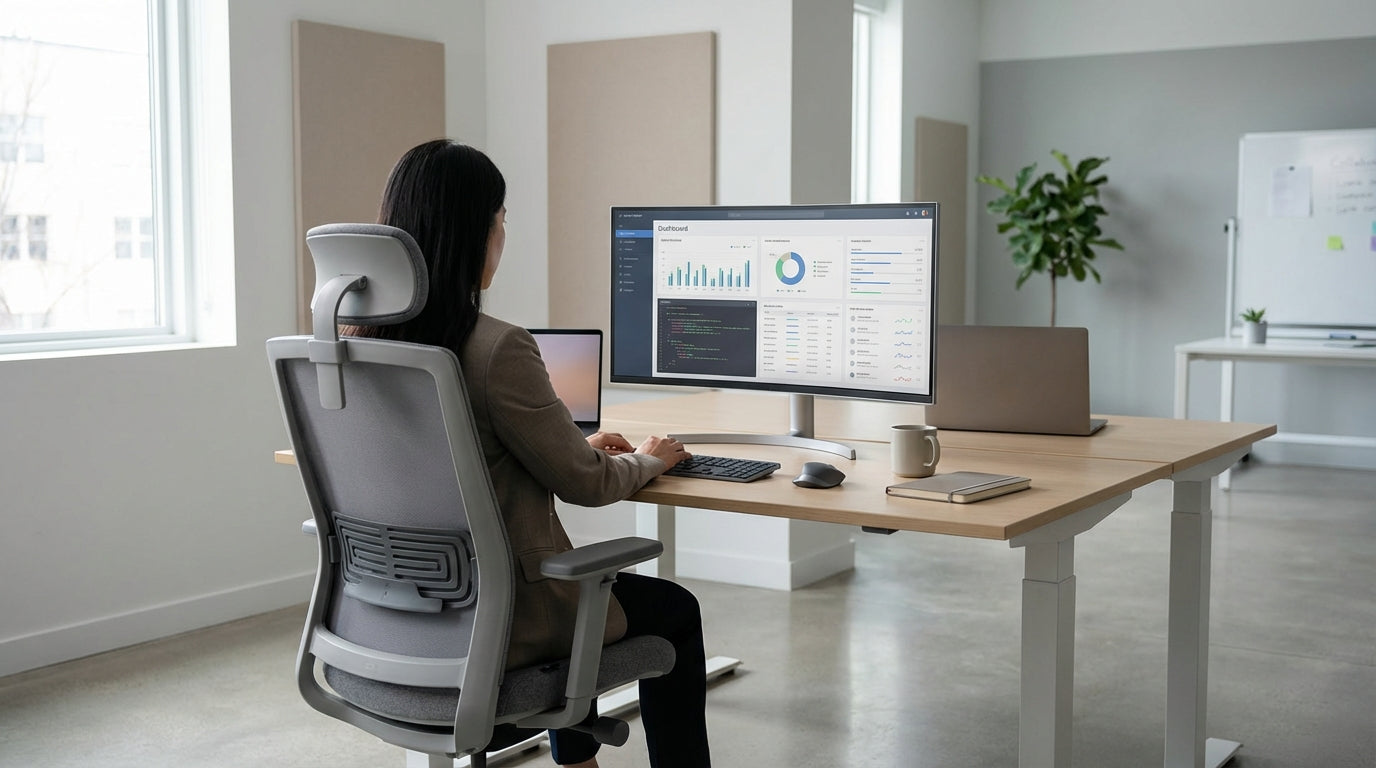
Understanding Your Body Type and Sitting Needs
Before you buy a new chair, it helps to understand how your body type affects the way you sit. Height, weight, hip width and even how broad your shoulders are all influence which office seating will genuinely support you.
Taller people often struggle with seats that are too short, forcing their knees higher than their hips and creating pressure in the lower back. Shorter users face the opposite problem: legs dangling, feet not flat on the floor, and pressure under the thighs cutting off circulation. Broader hips can feel cramped in narrow seats, while slender frames may “swim” in chairs with deep seats and wide backs.
If you’re heavier or spending long hours at a desk, it’s important to look for a higher weight rating and sturdier construction. Options like dedicated Heavy Duty Chairs are designed to provide stronger bases, reinforced mechanisms and more durable cushioning, all of which help the chair maintain its support over time.
Your work style also matters: someone who leans forward to focus on detailed tasks has different needs to a person who reclines frequently during calls. Matching your body type with your posture habits is the best way to narrow down the right style, whether that’s a breathable Mesh Office Chair for all‑day computer work or a cushioned executive model for mixed desk and meeting use.
Key Ergonomic Features to Look For
Ergonomics simply means designing equipment to fit people, not the other way around. A good chair should adapt to your body, support neutral posture and reduce strain on joints and muscles.
Start with height adjustment: your feet should sit flat on the floor, with knees roughly at a 90‑degree angle and hips level or slightly higher. The seat pan (the bit you sit on) should allow 2–3 fingers of space between the front edge and the back of your knees to avoid cutting off blood flow. Depth adjustment is especially helpful for shorter or taller users, letting you “bring the seat” to your legs instead of compromising your posture.
Lumbar support is the curved part of the backrest that supports your lower spine. Adjustable lumbar—both in height and sometimes in firmness—lets you place that curve where your lower back naturally arches. This is essential if you have a pronounced curve or, on the other hand, a flatter lower back shape. Many modern Task Chairs offer adjustable lumbar systems aimed at everyday computer work.
Armrests should adjust in height at a minimum, so your shoulders can relax and your elbows sit close to 90 degrees. Width and depth-adjustable arms suit broader or narrower shoulders and keep your arms aligned with your keyboard. Look for tilt mechanisms that allow you to lean back smoothly, with tension control so lighter and heavier users can both recline comfortably. These fundamentals matter across categories, from basic Visitor Chairs for short stays through to premium Leather Chairs for executive offices.
Chair Styles That Suit Different Body Types
Different bodies feel better in different chair styles. Matching the frame, cushioning and adjustability to your build makes a real difference to daily comfort.
For petite users, chairs with narrower seats, shorter seat depth and a lower gas lift are crucial. Standard office seating often leaves shorter people perched on the edge of the seat to reach the floor, which removes support from the back altogether. Compact Task Chairs with sliding seat pans are a smart choice, and a footrest can also help maintain ideal leg position if your desk height can’t be changed.
Taller bodies usually need longer seat pans, higher backs and a gas lift that goes up further than standard. Look for higher backrests that support the upper shoulders and neck instead of cutting off mid‑back. Many tall users also appreciate breathable Mesh Office Chairs, which distribute weight without trapping heat across a broader back and shoulders.
Heavier users benefit from reinforced designs, wider seats and higher weight ratings. Dedicated Heavy Duty Chairs are engineered to handle greater loads, with stronger gas lifts and bases, denser foam and often broader arm spacing. For people with limited mobility or those who find standing from a seated position difficult, powered options like Power Lift Chairs can tilt and rise to help you move more safely without straining knees, hips or backs.
Matching Chair Type to Your Workspace
Your body type is only half the equation; the environment you sit in also steers which chair will work best. Consider your desk height, floor type and the tasks you perform most often.
If you work at a standard-height desk and spend most of the day at a computer, adjustable Task Chairs are a versatile starting point. They’re built for focused work, with fine-tuned controls for seat height, tilt and lumbar support. In warmer parts of Australia or non‑air‑conditioned offices, the airflow from Mesh Office Chairs can make a big difference in comfort across long days.
For design, drafting or lab work at benches and higher surfaces, look at seating that safely reaches the height you need. Adjustable Drafting Chairs and dedicated Lab Chairs & Stools give extra height range, foot rings for leg support and durable surfaces that cope with more demanding environments. These models are particularly helpful for taller or heavier users who need stable support at elevated positions.
Shared spaces such as meeting rooms and reception areas call for seating that fits a wide range of bodies without constant adjustment. Sturdy Meeting Chairs and welcoming Visitor Chairs should offer generous seat width and back support so guests of all shapes are comfortable. In more premium settings, Leather Chairs add a polished aesthetic while still providing ergonomic features like contouring and padding suitable for longer discussions.
Materials, Build Quality and Long-Term Support
The fabric, foam and frame you choose play a big role in how a chair feels over time. Quality matters even more if you’re heavier, taller, or sitting for long stretches every day.
Mesh backrests contour naturally to your spine while allowing airflow, which is especially handy in Australian climates. They tend to feel more supportive for medium and larger frames who like “firmer” feedback from the chair. Cushioned seats in premium Leather Chairs or fabric-upholstered models can feel softer at first, but the density of the foam determines whether they sag or hold their shape down the track. For heavier users, denser foam combined with a strong inner frame is essential to avoid bottoming out.
Look for chairs with strong bases (steel or high-grade nylon), quality castors and tested weight ratings. Collections like Australian Made Chairs often meet local standards and are designed with Australian body types and work habits in mind, which can mean better fit and durability. If you regularly host clients or run workshops, investing in robust Meeting Chairs and supportive Visitor Chairs ensures everyone is comfortable, not just your core team.
Finally, think beyond your current needs. If your weight may change, or if more than one person will use the same chair, choose models with generous adjustability and higher weight capacities. Whether you land on a breathable mesh task model, a high-capacity Heavy Duty Chair, a powered Power Lift Chair, or locally built Australian Made Chairs, aligning build quality with your body type and daily use is what delivers long‑term comfort and support.


