

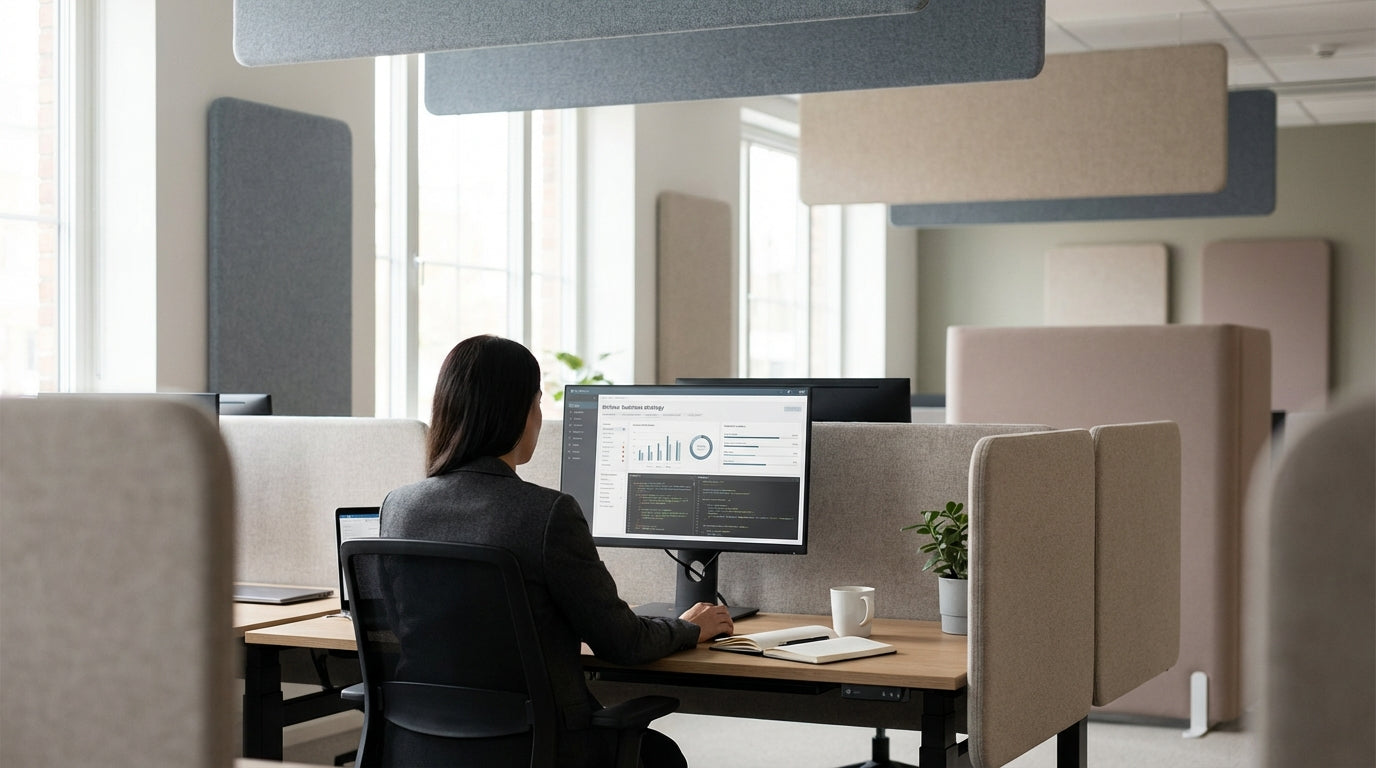
Why Noise Control Matters in Open-Plan Offices
Open offices can boost collaboration, but they’re often loud, distracting and tiring. Reducing sound levels is essential for focus, wellbeing and professional phone or video calls.
In an open-plan space, sound travels freely from phone conversations, keyboards, printers and casual chats. This constant background noise increases cognitive load, which means your brain has to work harder just to filter it all out. Over time, that can lead to fatigue, stress and a noticeable drop in productivity.
From a business perspective, poor acoustics can affect everything from staff retention to client perception. When meetings are interrupted by noise or confidential conversations are easily overheard, it can undermine trust and professionalism. Investing in smart acoustic solutions is not just about comfort; it directly supports performance and privacy.
Modern acoustic design focuses on managing how sound behaves rather than trying to eliminate it completely. By combining furniture, partitions and specialist materials, you can create a balanced sound environment where collaboration and concentration can comfortably coexist.
Identifying Common Noise Sources in Shared Workspaces
Before you invest in sound control, it helps to understand where noise is coming from. Most distractions fall into a few clear categories.
Speech is usually the biggest issue in open offices. Nearby conversations, impromptu meetings at someone’s desk and video calls can all become unintentionally disruptive. Even when people speak softly, human voices carry well across hard surfaces like glass, concrete and plasterboard.
Equipment and building services add their own layer of sound. Printers, scanners, HVAC systems and sliding chairs create ongoing background noise that bounces around the room. Hard floors and minimal soft furnishings make this worse, because there’s nothing to absorb or diffuse the sound waves.
Understanding these sources allows you to choose targeted solutions: for example, creating quieter zones using partition workstations, adding acoustic finishes on large hard surfaces, or introducing semi-enclosed spaces for focused work and calls.
Using Furniture Layout and Partitions to Control Sound
The way you arrange desks and partitions has a major impact on how sound travels. Smart planning can reduce noise without sacrificing the open feel.
Start by zoning the office according to activity and noise level. Group collaborative areas away from quiet focus zones, and position high-traffic pathways so they don’t cut directly through concentrated workspaces. Products like Single Person Workstations, 2 Person Workstations and 4 Person Workstations can be arranged to create “pockets” of calm surrounded by more active areas.
Partitions are one of the most effective tools for controlling direct sound paths. Desk Mounted Partitions help block line-of-sight between people, which also reduces how clearly speech carries. For larger changes to the space, Floor Partitions can act as movable walls, breaking up big echo-prone rooms into acoustically softer zones without needing a full fit-out.
When you combine furniture and screens into a cohesive plan, you effectively build a layered barrier system. Dedicated partition workstations give teams a defined boundary for sound and movement, making it easier for staff to maintain focus while still feeling connected to the wider office.
Acoustic Materials: Walls, Ceilings and Visual Design
Soft, porous materials are crucial for absorbing excess sound in open spaces. The goal is to stop sound from bouncing around the room.
Large, flat walls are prime culprits for echo and reverberation. Installing products such as Acoustic Wall Tiles adds texture and sound absorption exactly where noise reflections are strongest. For a more decorative approach, Acoustic Wall Art combines sound control with visual interest, allowing you to support your brand or interior style while improving speech clarity.
The ceiling is often the biggest unused surface in an office, and an excellent place to tackle overall noise levels. Acoustic Ceiling Traps work by capturing sound energy that rises and would otherwise bounce back into the space. This reduces the overall “loudness” of the room and makes it easier for people to hear the conversations that actually matter to them.
By mixing acoustic finishes across walls and ceilings, you can significantly cut down reverberation time, which is the period sound hangs around after the source has stopped. This creates a more controlled, comfortable soundscape where discussions stay local instead of bleeding across the whole floor.
Quiet Zones, Focus Pods and a Balanced Sound Strategy
A well-designed office doesn’t need to be silent; it just needs the right spaces for each task. Purpose-built quiet areas are a key part of that mix.
Enclosed or semi-enclosed spaces such as Office Pods provide immediate relief from open-plan noise. They’re ideal for video calls, confidential chats or deep-focus work that’s hard to maintain on the main floor. Because they’re self-contained, pods also stop those conversations from spilling into the wider workspace, improving privacy for everyone.
At the desk level, combining tailored furniture with acoustic treatments builds a strong foundation for day-to-day focus. Staff who spend most of their time on detailed tasks can benefit from quieter clusters built from Single Person Workstations and locally placed Acoustic Wall Tiles or Acoustic Wall Art. Teams that collaborate heavily can work from shared 2 Person Workstations or 4 Person Workstations, supported by Floor Partitions to keep noise local.
The most effective acoustic strategy is layered and adaptable. Use pods, partitions, partition workstations, wall treatments and Acoustic Ceiling Traps together so people can move between collaborative zones and quiet spaces as their work changes through the day. Over time, this balanced approach supports better concentration, clearer communication and a more comfortable, productive workplace for everyone.


