

Understanding Australian Standards and Public Sector Obligations
Government offices in Australia face stricter requirements than most private workplaces. Furniture choices must support safety, accessibility, durability, and value for public money.
At a minimum, agencies should ensure workstations, desks and chairs comply with relevant Australian Standards such as AS/NZS 4442 for office desks and AS/NZS 4438 for office seating. These standards cover stability, strength, and ergonomic performance so staff can work safely over long periods. Choosing compliant Straight Desks and ergonomic Task Chairs reduces the risk of musculoskeletal injuries and costly workers’ compensation claims.
Public sector procurement rules also emphasise value, transparency, and whole-of-life cost. That means agencies need to consider not just the purchase price, but maintenance, warranty coverage, and replacement cycles. Opting for commercial-grade furniture with solid warranties helps meet these obligations, especially in high-traffic service centres or shared spaces.
Accessibility is another key obligation under the Disability Discrimination Act and the associated Premises Standards. Furniture layouts must allow safe movement for people using mobility aids, as well as appropriate desk heights and clear knee space. Incorporating Height Adjustable Workstations can make it easier to accommodate staff or visitors with varied needs without bespoke fit-outs each time.
Designing Compliant Workstations and Desks
A compliant workstation needs to do more than just fit in the room. It must support good posture, clear workflows, and safe cable and document management.
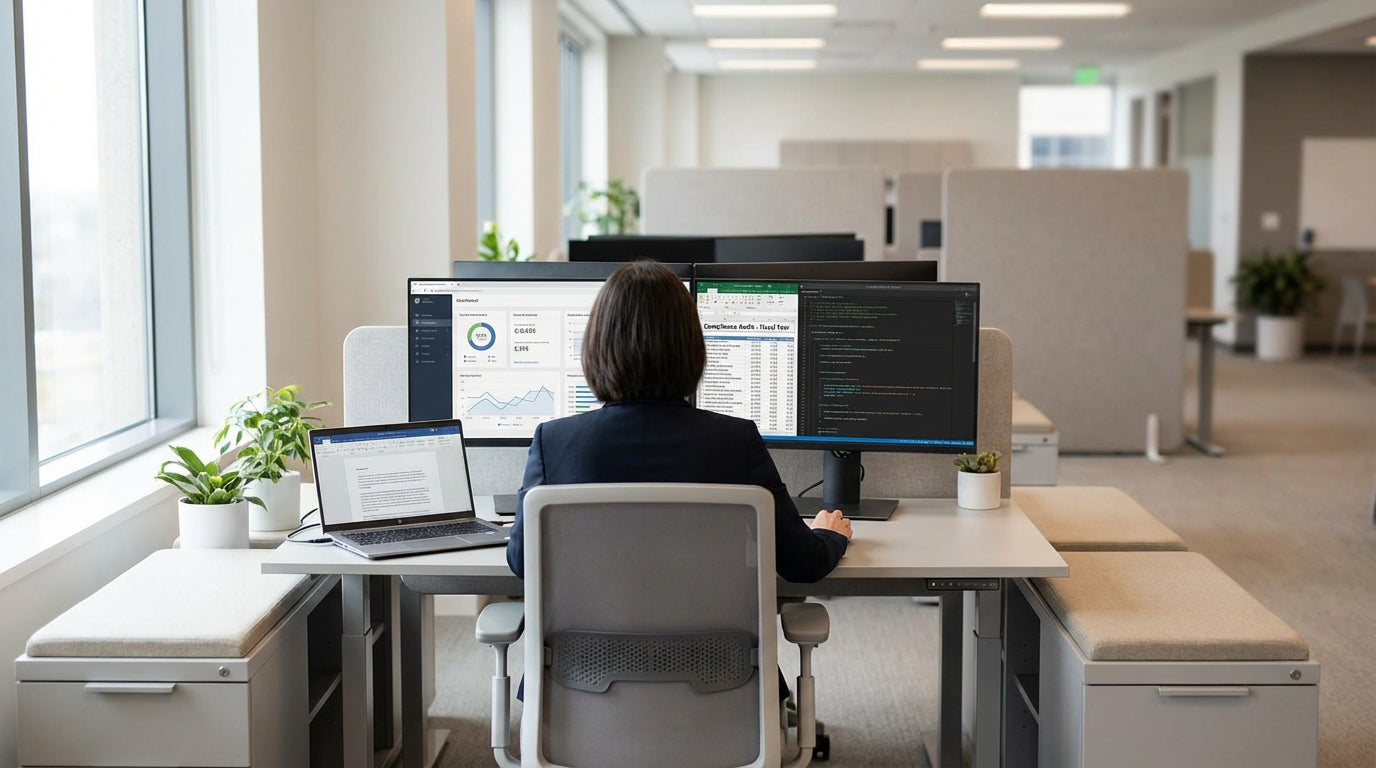
When planning individual workpoints, start with the core desk configuration. Standard fixed-height options like quality Straight Desks suit many roles, especially in shared hot-desk environments or call centres. For staff who need more privacy or equipment space, modular Single Person Workstations allow screens, cable trays, and storage to be integrated while still complying with safety and ergonomic guidance.
Sit-stand setups are increasingly common across federal, state and local agencies, particularly in health, regulatory and ICT teams. Height Adjustable Workstations let staff alternate between sitting and standing, which can reduce strain and encourage movement throughout the day. To remain compliant, ensure there is sufficient clearance for monitor arms, safe cable routing, and stable frames that will not tip when loaded with equipment.
Seating is just as critical as the desk itself. Ergonomic Task Chairs with adjustable seat height, backrest angle, and lumbar support allow staff to customise their setup to their body size and tasks. For government departments, it is worth standardising on a small range of compliant models that can be easily repaired and reallocated across teams as staffing changes.
Finally, consider how workstations interact with storage. Locating Filing Cabinets and Office Cupboards near desks can minimise unnecessary walking and manual handling, while still allowing adequate circulation space and emergency egress routes that meet building safety requirements.
Ergonomics, Health and Safety in Government Offices
Ergonomics is about designing work to fit the worker, not the other way around. Done well, it supports staff wellbeing, productivity, and compliance with WHS duties.
For desk-based public servants who spend long hours at a computer, even small design choices can have big impacts over time. Adjustable Task Chairs, suitable desk heights, and adequate monitor distance all help reduce eye strain, neck pain, and repetitive strain injuries. Agencies should document standard workstation setup guidelines and provide simple self-assessment checklists so employees can fine-tune their own work areas.
Where possible, include options for movement within the workstation itself. Height Adjustable Workstations make it easier for staff to change posture throughout the day, which can reduce discomfort and fatigue. In higher-level roles, larger Manager Desks can be paired with ergonomic accessories like footrests and monitor arms to maintain safe working positions while accommodating meetings or paperwork.
Meeting environments should not be overlooked in health and safety planning. For long briefings or training sessions, stable Meeting Tables and supportive seating are essential to avoid discomfort and distraction. In executive areas, appropriately sized Boardroom Tables allow documents, laptops and catering to be accommodated without clutter, reducing trip risks from bags or excess cabling around the floor.
Regular reviews of office layouts and equipment help ensure continued compliance as staffing and technology change. Involving health and safety representatives, along with facilities and HR teams, ensures that any new Single Person Workstations or shared spaces are assessed through a WHS lens before rollout, rather than being retrofitted later at higher cost.
Secure Storage, Records and Data Protection
Government agencies must protect both physical records and personal belongings. The right storage furniture is central to meeting these obligations.
Many departments still handle paper-based files, originals, and evidence that must be locked away when not in use. Robust, lockable Filing Cabinets are ideal for active records, while tall Office Cupboards can secure stationery, IT peripherals, and sensitive hard-copy documents. For shared environments or shift-based roles, Steel Lockers give staff a secure place for personal items, which supports both security policies and a tidy, professional workspace.
Information security frameworks often require clear separation between staff personal storage and official records. Locating Steel Lockers away from records storage reduces the risk of accidental mixing of personal and government property. Meanwhile, clearly labelled Office Cupboards and Filing Cabinets help teams implement retention schedules and destruction policies consistently across sites.
Physical security also means considering where storage is placed. Positioning high-use cabinets near relevant Straight Desks and Single Person Workstations can reduce the temptation to leave sensitive material on desks. In meeting and executive areas, credenzas paired with Boardroom Tables or Manager Desks allow quick pack-down of documents at the end of briefings, keeping surfaces clear and information secure.
Planning Government Fit-Outs for Flexibility and Longevity
Public sector offices need to adapt to policy changes, restructures, and hybrid working. Furniture choices should support flexibility without breaching compliance.
Modular systems are particularly valuable in this context. Using a mix of Straight Desks, Single Person Workstations, and Height Adjustable Workstations allows agencies to reconfigure teams quickly as projects begin or end, while maintaining safe access and clear egress routes. For managers and directors, durable Manager Desks in standard sizes make it easier to relocate offices or consolidate floors without bespoke joinery.
Shared spaces also need to be planned with versatility in mind. Stackable seating and reconfigurable Meeting Tables can support everything from daily stand-ups to formal consultations. In larger agencies, investment in formal Boardroom Tables is often balanced with more casual collaboration areas to suit different engagement styles, from community reference groups to cross-agency steering committees.
To maximise longevity, choose commercial-grade finishes that withstand frequent cleaning and heavy daily use common in government settings. Coordinating storage elements like Office Cupboards, Filing Cabinets, and Steel Lockers across sites can create a consistent look and simplify asset management. With a clear furniture standard in place, departments can roll out new or refurbished spaces more quickly while staying aligned with procurement, WHS and accessibility requirements.


