

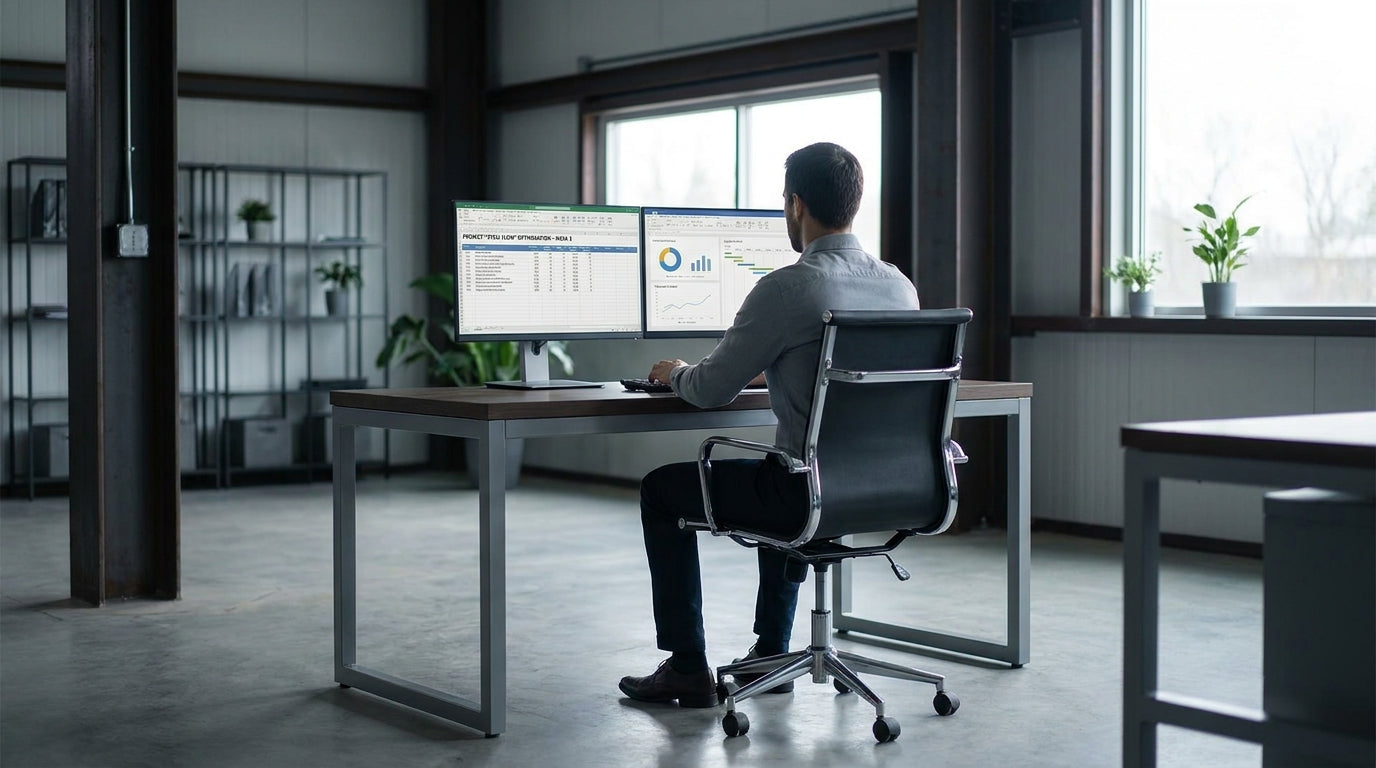
Designing a Safe, Efficient Admin Zone in a Metalwork Environment
The admin area in a metal fabrication shop has different needs to a standard office. You’re dealing with noise, dust, and high-vis traffic moving between the workshop and the front desk.
Start by separating clean admin space from the production floor as much as possible, using walls, doors or at least visual barriers. This helps keep paperwork clean, electronics protected, and conversations audible when phones are ringing or clients walk in. Locate reception and planning desks where staff have clear sightlines to entry points and, if needed, windows into the workshop for quick checks on jobs and deliveries.
Space planning is crucial in busy industrial settings. Give each role a dedicated footprint: reception, production planning, purchasing, WHS administration, and management. Use modular layouts with Single Person Workstations for focused roles and 2 Person Workstations where collaboration is constant. This reduces bottlenecks around shared computers and minimises people crossing each other’s paths with folders, samples, or drawings in hand.
Don’t overlook safety and compliance in the “office” side of the shop. Ensure walkways to the workshop are clearly defined and kept free of boxes and chairs. Hard-wearing flooring and easy-clean surfaces are worth the investment, especially in entry paths where metal dust and grease can be tracked through. Combine this with strategically placed storage so PPE, documentation, and tools don’t overflow into work areas.
Choosing Desks That Suit Fabrication Admin Workflows
Admin teams in metalwork shops juggle drawings, purchase orders, scheduling, and client files. Desks need to handle both computer work and large-format paperwork.
For managers who switch constantly between screens, plans, and quick meetings, robust Manager Desks provide extra depth and surface area. These are ideal for handling oversize fabrication drawings, quoting folders, and inspection reports without everything piling up dangerously close to the keyboard. Front-of-house or reception staff who mostly handle computer-based tasks are usually well-served by streamlined Straight Desks, which keep layouts simple and make cable management easier in high-traffic spaces.
When admins regularly spread out workshop plans or nesting layouts, corner configurations can be more productive. L-Shaped Desks provide a clear separation between “computer zone” and “paperwork zone”, reducing clutter and making it easier to keep laptops and monitors free from dust and swarf that might come in from the factory. This type of desk also gives drafters or schedulers space for dual monitors and reference material without wasting floor area.
Where teams are growing or you’re consolidating multiple admin roles, workstation systems are worth considering. Configurable Partition Workstations allow you to cluster staff while still giving each person a defined space. In industrial admin, this helps keep job cards, tooling records, and quality control documents from getting mixed up, while still allowing quick communication between production planning, purchasing, and logistics.
Chairs and Ergonomics Built for Heavy-Duty Use
Office seating in a metalwork business has to cope with long hours, heavier users, and often tougher conditions. Comfort affects both productivity and safety.
Standard office seating may not survive the realities of fabrication admin areas, where staff might come and go in work boots and occasionally carry parts or heavy folders. Ergonomic Task Chairs with adjustable height, lumbar support, and seat tilt help staff stay comfortable during detailed work like quoting, CAD drafting, or compliance paperwork. Look for durable fabrics and mechanisms, as cheaper chairs can quickly fail under constant daily use.
For supervisors, estimators, or workshop controllers who move frequently between the factory and the office, sturdier options are often essential. Heavy Duty Chairs are designed for higher weight ratings and intensive use, offering stronger frames and longer-lasting components. These are especially suitable for 24/7 operations, rotating shifts, or shared seating where multiple people use the same chair across the week.
Ergonomics is more than just the chair. Combine height-adjustable seating with correctly sized desks so elbows are roughly at right angles when typing, and monitors are at eye level to reduce neck strain. In busy metalwork offices, where staff may also be on the phone with suppliers or clients for extended periods, a well-set up workstation reduces fatigue and helps prevent repetitive strain injuries over the long term.
Smart Storage for Tools, PPE, and Sensitive Documents
Metalwork admin areas often have to store far more than just stationery. You’re dealing with PPE, technical files, and sometimes small tools or gauges.
Lockable Office Cupboards are ideal for filing manuals, safety documentation, calibration records, and archived job folders while keeping them protected from dust. Choose steel or commercial-grade units that can handle the extra weight of catalogues, metal samples, and spare components. Position cupboards close to where information is used most often, such as near WHS coordinators or quality control desks, so staff don’t waste time crossing the floor for every check.
Personal storage is equally important in industrial settings. Steel Lockers give staff somewhere secure to keep personal items, uniforms, or trade tools when they’re moving between the workshop and the office. This reduces clutter on desks and in walkways, while also supporting security and compliance where items like phones or personal tools need to be controlled. Lockers made from steel are also more resilient in environments where impacts, grime, and occasional moisture are part of daily life.
Think about how storage supports workflow. For example, keep PPE lockers close to exits that lead to the workshop, and place cupboards for forms and checklists near the point where supervisors complete inspections. When everything has a clear home, admin spaces stay tidy, and you spend less time hunting for missing files or equipment before audits, client visits, or urgent production meetings.
Creating a Productive Flow Between Workshop and Office
The biggest challenge in metalwork admin is coordinating communication between the factory floor and the front office. Furniture layout can support or hinder that flow.
Use grouped 2 Person Workstations or banks of Single Person Workstations to bring related roles together. For example, place scheduling, purchasing, and logistics close to each other to streamline discussions about material availability and freight. Acoustic screens within Partition Workstations help keep conversations intelligible, even when machinery noise filters through from the workshop.
Position managers where they can bridge both worlds. A well-appointed office using Manager Desks near the workshop entrance lets supervisors keep an eye on production while remaining accessible to admin staff and visitors. Complement this with practical Straight Desks at reception so visitors, delivery drivers, and inspectors are processed efficiently without clogging up internal pathways or disrupting concentrated work.
Finally, allow room for quick stand-up conversations and paperwork handovers. Clear bench areas or unused corners of L-Shaped Desks can double as temporary review zones for drawings and job cards with foremen or welders. When your furniture supports fast, organised communication between the workshop and the office, you reduce downtime, cut errors, and keep metalwork projects moving smoothly from quote to delivery.


