

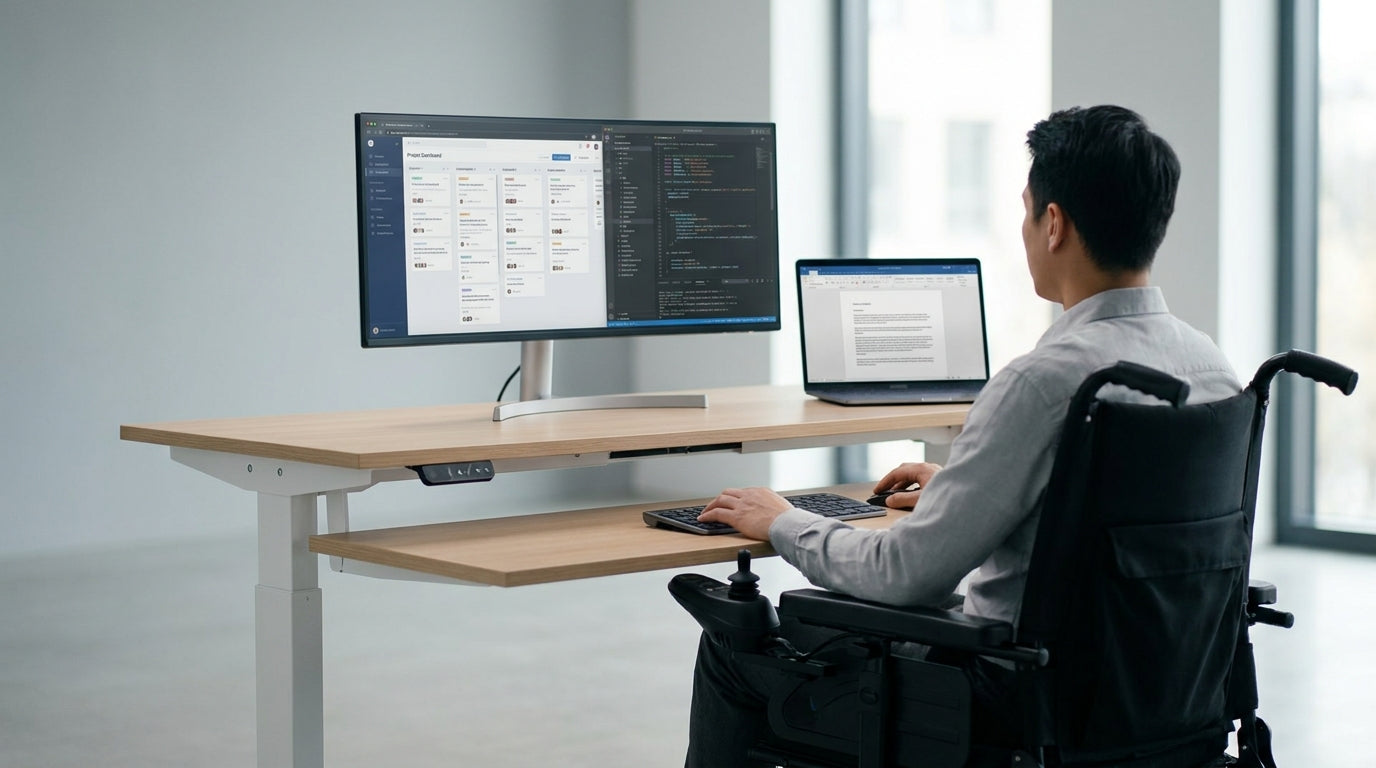
Understanding Accessible Desk Heights
Designing a desk for a wheelchair user isn’t just about comfort; it’s about safety, accessibility, and independence. Getting the height right helps prevent strain on the shoulders, neck, and wrists.
In Australia, accessibility guidance is influenced by standards such as AS 1428, which outline clearances and reach ranges for people using mobility devices. For desks and workstations, this translates into ensuring both the work surface height and the space underneath the desk suit a seated user in a wheelchair. Unlike fixed-height furniture, inclusive design allows for real-life differences in wheelchair size, cushion height, and user posture.
While a typical office desk might sit around 720–750 mm from the floor, this is not always suitable for wheelchair users. Wheel rims, armrests, and footplates all affect how close a person can get to the work surface. The aim is to allow the user’s elbows to rest close to 90 degrees when typing or writing, with relaxed shoulders and neutral wrists.
Clear knee and toe space are just as important as the surface height. This means planning enough width and depth so that the person can roll in fully without bumping their knees or footrests. Many modern Home Office Desks and Straight Desks can be chosen or adapted with this in mind.
Key Measurements and Clearance for Wheelchair Users
Before buying or setting up a desk, it helps to know the key measurements to aim for. These include worktop height, knee clearance, and the space needed to manoeuvre a wheelchair.
Comfortable desk height for many wheelchair users is usually in the range of about 680–800 mm from the finished floor level to the top of the work surface. Within this band, the optimal height depends on the user’s body proportions and the height of the wheelchair seat, including any cushion. Ideally, the work surface sits slightly above the user’s thighs, with room to cross the legs or adjust position without hitting the underside of the desk.
Knee clearance typically needs to be at least 700 mm high and around 800 mm wide, with a minimum depth of roughly 500–600 mm to allow the user to pull in fully. This under-desk space should be free from obstructions such as support panels, sharp brackets, or cable trays placed too low. When considering options such as Single Person Workstations or compact Student Desks, check product specifications carefully to confirm these dimensions.
Toe clearance, the space lower down where the feet and footplates sit, also matters. A gently recessed panel or cantilever leg design can make it easier for the wheelchair to get closer to the work surface. For multi-purpose spaces with shared furniture, such as training rooms using Training Tables or collaborative areas with Office & Meeting Tables, selecting designs with open bases and generous legroom can significantly improve accessibility.
Fixed-Height vs Height-Adjustable Desks
When planning an accessible workstation, one of the biggest decisions is whether to choose fixed-height or adjustable furniture. The right choice depends on who will use the desk and how often it needs to change.
Fixed-height desks, such as many classic Straight Desks, can work well if they are set up specifically for one wheelchair user and measured to their needs. The main advantage is stability and simplicity: once adjusted during installation, nothing needs to be changed day to day. However, fixed desks are much less flexible if different people use the same space, or if the user’s needs change over time due to new equipment, health conditions, or changes in wheelchair configuration.
Electric or crank-operated Height Adjustable Workstations are often the most inclusive solution. They allow the user to fine-tune the worktop height to suit different tasks such as typing, writing, crafting, or using assistive devices. This can be especially helpful in shared offices, hot-desking environments, or homes where multiple family members use the same desk at different heights.
Corner spaces and tricky room layouts can also be made more accessible with flexible furniture. For example, Corner Workstations with adjustable frames let wheelchair users position screens and equipment within easy reach while maintaining proper clearance underneath. Portable solutions like Mobile Tables can supplement a main desk, giving extra surface area that can be moved closer or further away as needed.
Setting Up an Accessible Home, Office, or Study Space
Once you know the target height and clearances, the next step is arranging the entire workspace. Good layout and furniture choices make daily tasks smoother and safer.
In home offices, combining accessible desk height with thoughtful storage and cable management is essential. A suitable desk from a range of Home Office Desks can be paired with drawers or shelves placed within comfortable reach zones, so the user doesn’t have to lean or twist excessively. Keep frequently used items between shoulder and hip height while seated, and avoid deep, low cupboards that require bending forward.
For students using wheelchairs, desk choice can affect both comfort and concentration. Sturdy Student Desks that allow wheelchairs to roll under easily will reduce strain over long study sessions. Pair the desk with an accessible layout that leaves at least 1500 mm turning space nearby so the wheelchair can rotate and approach from different angles. If the student shifts between classrooms or training spaces, look for environments equipped with adjustable Training Tables and accessible paths of travel.
In workplaces, accessible desk height must be integrated into a broader inclusive design approach. Individual Single Person Workstations with adjustable frames and open legroom can be combined with shared zones furnished with Office & Meeting Tables that also accommodate wheelchair users at the same level as other participants. This not only supports productivity but also helps avoid separating or isolating employees with disabilities during collaboration, training, or meetings.
Choosing the Right Desk Style for Your Needs
Different tasks call for different desk styles, and wheelchair accessibility needs to be factored into each choice. Matching the desk type to the user’s work patterns will give the best long-term result.
For focused solo work, ergonomic Single Person Workstations or streamlined Straight Desks offer a clean layout and easy access. These are ideal for computer-heavy roles, administration, and home-based jobs where the user spends most of their time at a single station. If extra surface area is needed for multiple monitors, documents, or devices, a well-planned Corner Workstation can deliver more space without compromising wheelchair manoeuvrability.
Creative professionals, engineers, and designers may benefit from specialised surfaces. Adjustable Drafting Tables allow the angle of the top to change, bringing drawings closer to eye level and reducing the need to lean forward. When combined with height-adjustable frames, these tables can accommodate both seated wheelchair use and occasional standing work for support staff or colleagues.
For dynamic environments—such as flexible offices, training rooms, or multipurpose spaces—mobile and reconfigurable furniture offers maximum versatility. Robust Mobile Tables can be rolled to the appropriate position and height-adjustable stations can be set for each user during setup. In education and training settings, mixing accessible Training Tables with standard layouts helps ensure that wheelchair users can participate fully without needing special arrangements at the last minute.
In every case, confirm the product measurements, especially the adjustable height range and clearances under the top. By pairing suitable furniture, such as Height Adjustable Workstations and well-designed Office & Meeting Tables, with thoughtful layout and planning, you can create accessible study, work, and collaboration areas that support independence and comfort for wheelchair users now and into the future.


