

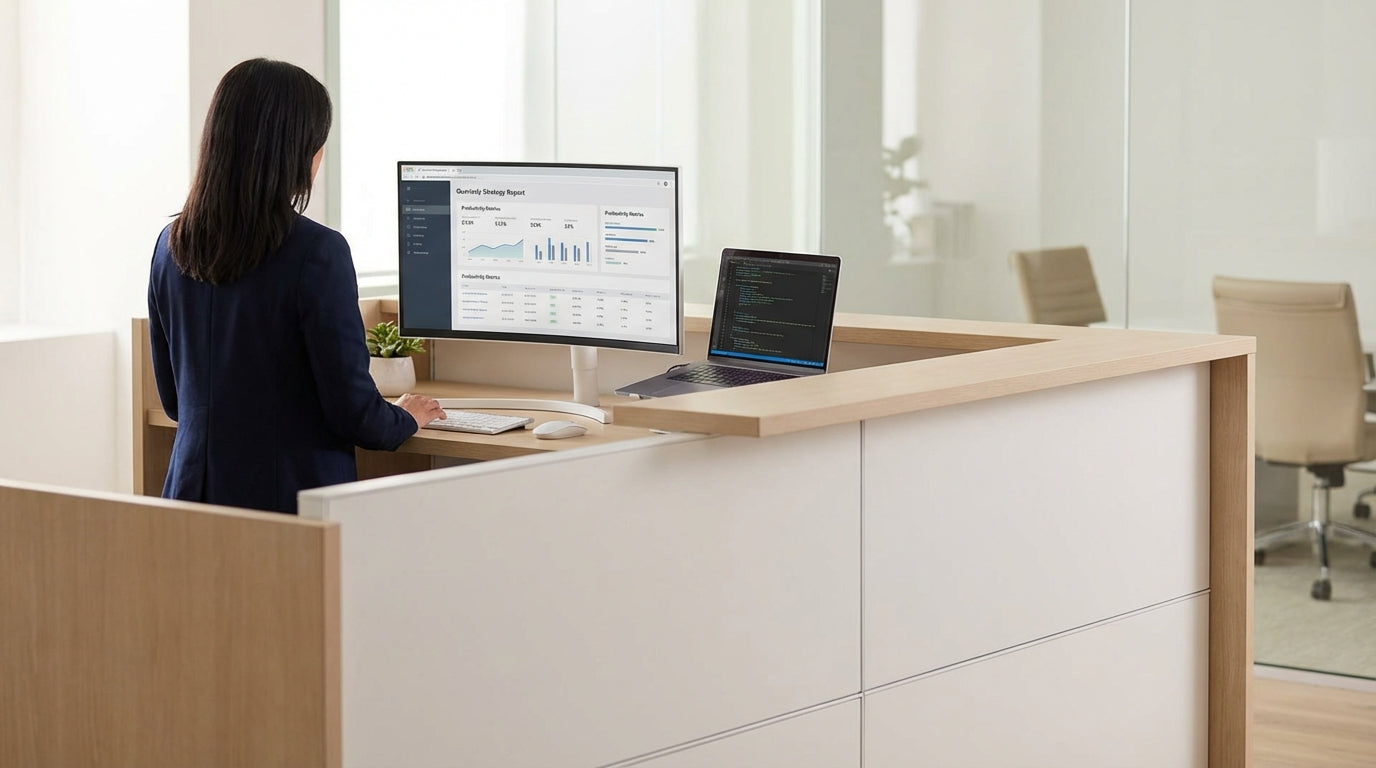
Why Reception Counter Height Matters More Than You Think
The height of your reception counter does more than hold a computer and a sign-in book. It shapes first impressions, comfort, accessibility, and even privacy for both visitors and staff.
In most Australian workplaces, the main transaction surface is typically in the range of 1050–1100 mm from the floor. This allows guests to stand comfortably while filling in forms, speaking with reception staff, or placing bags on the counter without hunching over. Behind the front panel, the work surface is usually closer to standard desk height, around 720–750 mm, so administrators can work for long periods with good ergonomics.
These two levels are often combined in modern reception counters, giving you a higher front for privacy and a lower rear for computer work. The balance between these heights affects line-of-sight to screens, how approachable the desk feels, and whether documents can be passed easily across the top. When you get it right, the counter works for every visitor, from someone quickly signing a delivery docket to clients needing a longer, confidential conversation.
Typical Height Ranges for Australian Reception Areas
Australian offices and medical suites tend to follow similar height guidelines, even though there’s no single law dictating an exact number for every space.
For the guest-facing ledge, many commercial fit-outs aim for around 1100 mm. This is comfortable for most adults standing, letting them rest a forearm on the surface without raising their shoulder. A lower front lip or writing shelf, around 900–950 mm, is sometimes added for people who are shorter or carrying bags and folders. At the staff side, a worktop height of about 730 mm allows standard office chairs and ergonomic posture, much like you’d find with quality straight desks or corner office desks.
Designers also consider how the counter fits with surrounding furniture such as reception seating and side tables. If your waiting chairs are low and casual, a very tall counter can feel like a barrier. On the other hand, in a corporate lobby with higher-backed chairs and formal styling, a taller counter can reinforce a more structured, professional look. Matching the counter height to your overall layout helps the space feel intentional rather than pieced together.
It’s also common to see different configurations depending on the counter form. Long, linear front desks – like many straight reception counters – often maintain a consistent front height for a clean look. More complex L-shaped reception counters may vary the height along one wing to build in a dedicated wheelchair-accessible section or a spot for longer consultations.
Balancing Ergonomics, Accessibility and Privacy
The right height has to work for everyone who uses the space, not just the person who ordered the furniture. That means thinking about staff, visitors, and people with mobility needs.
From an ergonomic perspective, reception staff should be able to type, write, and speak on the phone without reaching or shrugging their shoulders. A desk-height work surface at around 720–750 mm, paired with an adjustable chair, usually does the job. The higher front panel can then rise above that level to shade screens and paperwork from public view. This reduces visual clutter and helps maintain confidentiality for medical, legal, and financial practices in particular.
Accessibility is another critical factor. Inclusive design often includes at least one lower section, typically around 800–850 mm high, to be usable by wheelchair users and children. In many reception layouts, this is built into a corner or return section of an L-shaped reception counter, or as a dedicated lower panel in an otherwise standard-height desk. Clear knee space under this area, similar to the underside of single person workstations, makes it genuinely usable rather than purely decorative.
Privacy doesn’t only relate to screen visibility. A slightly higher front also helps hide cables, stationery, and personal items, making the area appear tidy. However, if the barrier is too tall, visitors can feel like they’re speaking “over a wall,” which is particularly uncomfortable for sensitive conversations. Finding the midpoint that protects information while still feeling open and friendly is where careful attention to height really pays off.
Choosing the Right Counter Style and Layout
Once you understand the functional height ranges, the next step is deciding how the counter shape supports your workflow and floor plan.
Long, linear desks are common in open foyers where you want a neat, uncluttered front. Many straight reception counters are designed with a consistent transaction height along the full length, making them ideal for hotels, gyms, and corporate lobbies with steady foot traffic. They pair well with streamlined back-of-house setups that might include straight desks or office & meeting tables behind the scenes for admin work and team discussions.
If your foyer is more compact or has awkward corners, L-shaped layouts can be more efficient. L-shaped reception counters maximise wall space, create natural zones for greeting and paperwork, and make it easier to integrate a lower accessible section. The return side can also double as a secondary work area, much like a built-in workstation, freeing up room for storage or small side tables in the waiting area.
Consider how visitors enter and move through the space. You want the counter height and shape to guide them naturally to the check-in point without confusion. Aligning the front of the desk with nearby reception seating or an adjacent cluster of office & meeting tables can subtly direct traffic. Adequate clearance between the front edge and any chairs or tables ensures that people arriving, waiting, and leaving are not crossing paths awkwardly.
Behind the counter, staff also need enough space to move between the reception desk and other furniture like single person workstations or additional corner office desks. A well-planned layout with coherent heights avoids bottlenecks, especially at busy times of day when multiple employees may be working the front at once.
Practical Tips for Measuring, Planning and Buying
Before you buy, it pays to measure carefully and visualise how the counter height will feel in your actual space. A few practical checks can save costly mistakes.
Start by measuring floor-to-ceiling height, door widths, and any existing fixtures. Mark the proposed counter height on a wall using painter’s tape at around 1050–1100 mm to mimic the front ledge, and at about 730 mm for the staff worktop. Stand at the tape line and act out typical tasks like signing in, handing over parcels, or greeting visitors. This quick exercise gives you a real-world sense of how different heights will interact with your body and your space.
Next, think about what needs to sit on and under the counter: computer screens, telephones, printers, storage units, and personal items. If you plan to place additional straight desks or single person workstations behind the reception, make sure the top of the reception counter hides that equipment without making staff feel boxed-in. In smaller foyers, integrated storage within the reception unit can reduce the need for extra furniture, freeing up room for essential reception seating and side tables for visitors.
When browsing reception counters online, pay close attention to listed dimensions and product drawings. Compare those to the circulation paths in your entry area and don’t forget to allow for chair movement behind the desk. Matching heights and finishes with adjacent office & meeting tables or nearby reception seating helps create a cohesive look that feels professional to every guest who walks through the door.


