

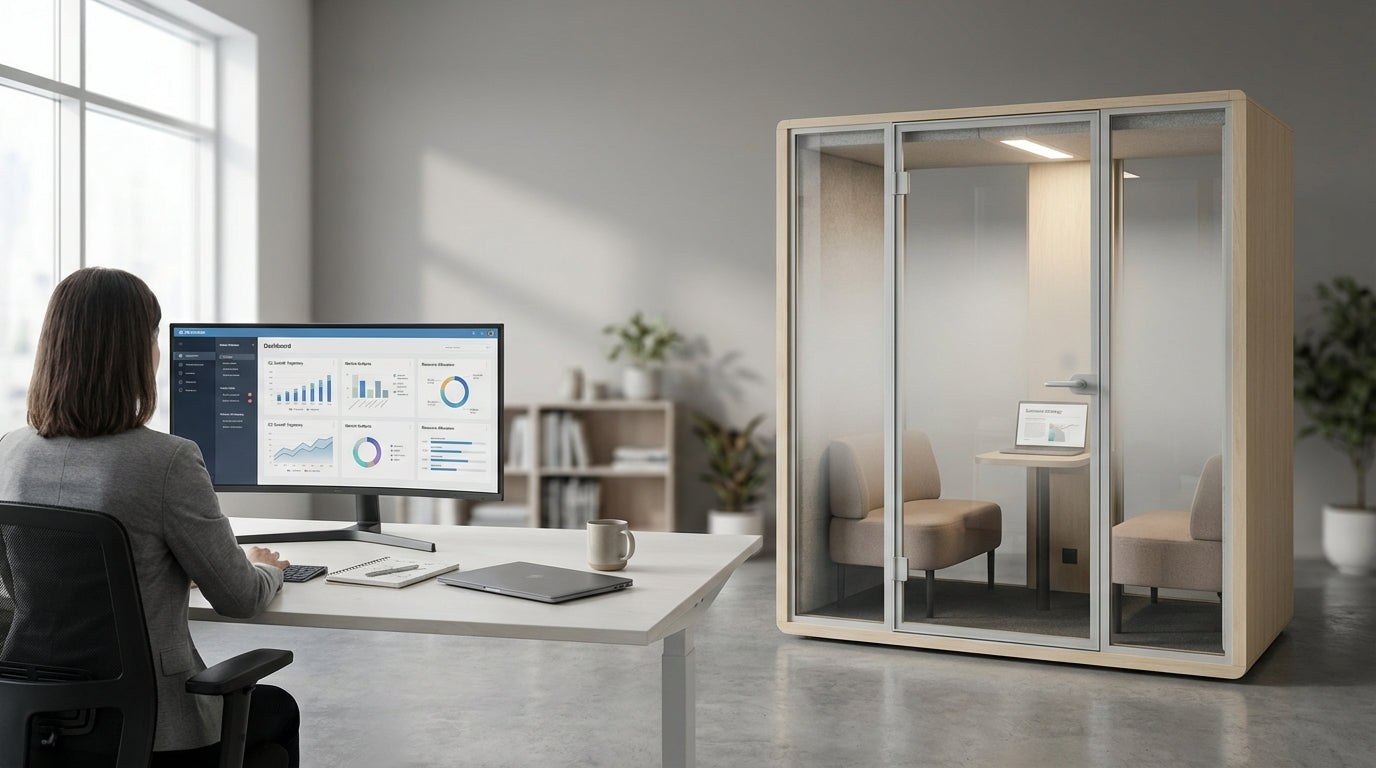
Why Enclosed Workspaces Are Booming in Aussie Offices
Open-plan layouts are noisy, distracted and often stressful. That’s why enclosed workspaces are becoming essential in modern Australian offices.
As hybrid work settles in, staff now jump between video calls, deep-focus tasks and quick stand-ups all in one day. Traditional meeting rooms can’t cope with this constant switching, and they’re too big for a quick one-on-one call. Compact enclosures and office pods solve this by creating on-demand quiet zones right where people sit, without needing a full office fit-out.
Sound-managed spaces support privacy for HR discussions, client negotiations and confidential strategy chats. They also give neurodivergent team members a calmer environment, which can significantly improve comfort and performance. By pairing pods with smart acoustic tools like acoustic wall art and acoustic wall tiles, you can tame the echo and chatter that usually dominate open offices.
From a facilities perspective, enclosed units are far more flexible than building new walls. They can be moved, reconfigured and scaled as headcount grows, or as your layout changes. When combined with mobile zoning tools such as mobile partitions and freestanding floor partitions, you gain a workspace that evolves with your business rather than locking you into a single design.
Key Features That Make a Pod Truly Private
Not every phone booth or cubicle delivers real privacy. Look for features that control both sound and visibility.
High-quality acoustic pods are built with multi-layer panels, sealed doors and acoustic glass that reduce sound leaking in or out. This matters for both sides of the conversation: the person inside should hear clearly, and people outside shouldn’t catch every word. A good benchmark is being able to speak in a normal voice on a call without anyone nearby understanding what’s being said.
Ventilation and lighting are equally important for calls that run back-to-back. Quiet fans that cycle air without a distracting hum help maintain comfort, especially in warmer Australian climates. Adjustable LED lighting lets staff avoid harsh glare on video calls, while still looking professional on camera. These design details separate premium solutions from makeshift “quiet corners” that people avoid.
Visual privacy can be boosted further by combining pods with surrounding desk mounted partitions or movable screens. In larger open areas, adding overhead solutions such as acoustic ceiling traps reduces overall reverberation, so the pod doesn’t have to work as hard to block ambient noise. The aim is a balanced acoustic environment where the whole space feels calmer, not just the interior of the pod.
Designing Spaces for Video Calls and Hybrid Meetings
Pods shine when they’re tailored for video calls, webinars and online interviews. Set them up to make digital collaboration effortless.
Start with furniture that suits the primary task. For focused solo work or longer online workshops, pair pods with ergonomic solutions like single person workstations or compact home office desks that fit neatly inside. If the unit is mainly for quick check-ins or stand-ups, a high bench and stool can encourage shorter, more energised meetings.
Cable management is often overlooked but crucial. Ensure there are power outlets, USB charging and network options inside the enclosure, so staff don’t need to juggle extension leads. Many teams now keep a simple “call kit” in each unit—headset, ring light and spare HDMI or USB-C cables—so anyone can step in and be camera-ready within seconds.
Acoustic tuning helps avoid echoey or “tinny” audio on calls. Combining the enclosed space with nearby acoustic wall art or textured acoustic wall tiles can soften reflections around the pod area, improving microphone clarity. This creates a more professional experience for clients and remote colleagues, and it reduces fatigue for staff who spend hours a day in virtual meetings.
Balancing Quiet Zones with the Rest of the Office
Pods work best as part of a bigger zoning strategy, not as isolated booths. The goal is a mix of quiet, collaborative and social spaces.
Think of your layout in layers. At the individual level, desk mounted partitions define personal space and reduce direct line-of-sight distractions. At the team level, mobile elements such as mobile partitions and larger floor partitions carve out neighbourhoods, huddle areas and team zones. Pods then act as “escape valves” within these areas, letting people duck away for a confidential call or deep-focus sprint.
Acoustic control should span the whole floor, not just the enclosed areas. Overhead treatments like acoustic ceiling traps help absorb sound that would otherwise bounce off hard surfaces. Visually appealing acoustic wall art can double as branding while quietly improving the soundscape. Together, these solutions reduce overall noise so fewer people feel they must retreat every time they need to concentrate.
Placement also matters. Locate enclosures near collaboration zones and circulation paths so they’re easy to duck into, but avoid high-traffic pinch points like lift lobbies or kitchen doors. Where possible, cluster multiple units and complement them with open desks or single person workstations nearby, giving staff a clear choice between quick calls, quiet solo work and more social settings.
Choosing the Right Mix for Your Team and Budget
Before investing, match solutions to how your people actually work. A quick audit of meetings and call patterns can save serious money.
If most calls are one-on-one or short client check-ins, a few smaller office pods may outperform building extra meeting rooms. Teams that do long-form analysis or writing will benefit from more individual focus points, such as a blend of pods, single person workstations and desk zones defined with desk mounted partitions. On the other hand, if your culture leans heavily on group workshops, invest in a couple of larger enclosures supported by flexible floor partitions that can open or close spaces as needed.
Budget-conscious fit-outs can start with acoustic “quick wins” and scale up. Combining acoustic wall tiles, acoustic ceiling traps and mobile partitions can dramatically improve speech privacy even before you add pods. As needs grow, you can layer in dedicated acoustic pods for high-priority roles like HR, finance, legal or sales leaders who handle sensitive conversations.
Finally, keep hybrid and remote work in mind. Many organisations are now mirroring office setups at home with quality home office desks and simple acoustic treatments, so staff have a consistent experience wherever they work. By viewing your office, pods and remote setups as one connected system, you can offer your team reliable privacy and focus—whether they’re in the CBD, a suburban hub or their spare room.


