

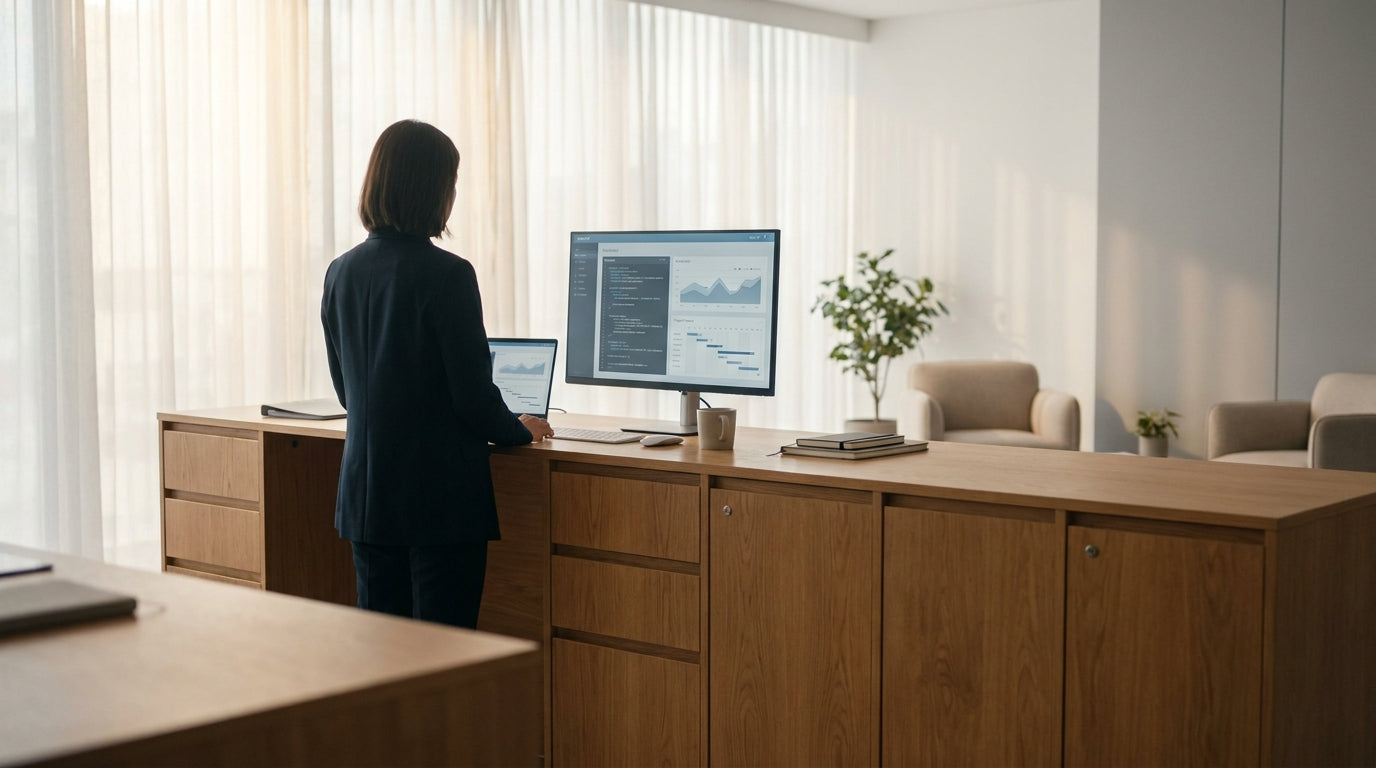
Understanding Storage-Friendly Reception Counters
Reception areas need to look welcoming while still working hard behind the scenes. Storage is a big part of that, especially in busy Australian workplaces.
A storage-efficient counter keeps paperwork, tech, and personal items organised without cluttering the surface your visitors see. When everything has a place, reception teams work faster, lose fewer documents, and maintain a more professional look. The right design also reduces the need for extra furniture, which helps in compact foyers and medical or corporate waiting rooms where space is at a premium.
To work out which style will give you the most storage, it helps to think about how space is used vertically and horizontally. Counters that combine drawers, cupboards, and shelving behind the front panel tend to outperform simple, minimal designs. It’s also worth considering how well the counter integrates with additional storage such as office cupboards, filing cabinets, and pedestal drawer units so the whole reception zone works together.
Comparing Popular Reception Counter Layouts
Different layouts store very different amounts, even if they look similar from the front. Shape, depth, and height all influence how much usable space your reception team actually gets.
Corner and multi-sided designs usually offer the greatest storage potential because they wrap around the receptionist, creating more under-bench area. An L-shaped reception counter is a good example: the return section can house extra drawers, CPU towers, or under-desk storage without taking up additional floor space in the public zone. By contrast, compact straight reception counters often prioritise a slim footprint over capacity, which can limit the number of shelves and cupboards you can include.
Standard reception counters with a simple, linear front can still work if your paperwork is mostly digital and you supplement the desk with nearby storage. Pairing a minimalist counter with tall office shelving or secure stationery cupboards behind the desk will increase capacity without cluttering the client view. The key is matching the counter layout to your daily tasks – high-traffic medical clinics, law firms, and schools typically need deeper, more enclosed units than small studios or co-working hubs.
Also consider desk height. Counters with a raised front panel and a lower work surface behind it create a hidden “well” where monitors, documents, and phones can sit out of sight. This configuration often allows for more drawer and cupboard modules underneath compared with fully open, bench-style designs.
Why L-Shaped Designs Usually Offer the Most Storage
In most offices, L-shaped layouts deliver the best balance of storage, privacy, and workflow. They make smart use of corners that would otherwise be wasted.
An L-shaped reception counter effectively gives your receptionist two work zones: a main front-facing side for greeting visitors and a return side for admin tasks. This second run of benchtop is ideal for printers, label makers, and phones, while the underspace can be fitted with pedestal drawer units or integrated cupboards. Because the counter wraps around the user, everything is within easy reach, increasing efficiency and reducing clutter on the visible front edge.
The corner section between the main and return sides is particularly valuable for storage. Many designs use this zone for deep drawers, CPU shelves, or lockable compartments for confidential files. When combined with nearby office cupboards and vertical hutch storage units, an L-shaped configuration can easily handle heavy paper-based workflows like those in medical centres, community services, and larger corporate offices.
Another benefit is separation of tasks. Documents awaiting filing can live on the return side, away from the client-facing bench. This keeps your public area tidy while still giving staff instant access to what they need. For organisations expecting future growth, choosing an L-shaped base and adding extra storage modules over time is often more flexible than replacing a smaller straight counter entirely.
Boosting Capacity with Smart Add-On Storage
Even a basic counter can hold more when you pair it with the right accessories. Think of the desk as the hub, and everything else as support.
Under-desk drawer pods, such as pedestal drawer units, are a simple way to add lockable personal and document storage without changing the counter itself. For bulk files and archives, matching filing cabinets can sit just behind or beside the reception zone, keeping sensitive information secure but accessible. If you handle lots of forms, brochures, or marketing material, open office shelving lets staff grab what they need quickly while keeping the front of house looking neat.
Vertical solutions are especially useful in smaller Australian offices where floor space is tight. Wall-mounted or desk-sitting hutch storage units add shelves and cupboards above the counter, using height instead of width. Pairing these with tall office cupboards or dedicated stationery cupboards means you can store cleaning supplies, surplus stationery, and seasonal items off the main desk entirely.
When planning these add-ons, map out how staff move through the space. Frequently used documents should be within arm’s reach, while rarely accessed archives can sit higher or further away. By zoning your storage in this way, even a modest straight reception counter can function like a much larger unit, supporting efficient, paper-heavy workflows without overwhelming the reception area.
Choosing the Right Setup for Your Australian Workplace
The most storage-heavy option isn’t always the best fit for every business. Your ideal setup depends on what you store, how you work, and how much space you have.
If you deal with a constant flow of visitors and paperwork, a well-planned L-shaped reception counter combined with nearby filing cabinets and office shelving will usually give you the greatest overall capacity. For design studios, clinics with mostly digital records, or small practices where floor area is tight, a streamlined straight reception counter backed up by tall office cupboards might be more practical. In both cases, adding pedestal drawer units under the desk gives staff secure spots for valuables and active files.
Think about privacy and security as well as volume. Lockable compartments are essential in medical, legal, and education settings where confidential information is handled at the front desk. Combining a solid-front reception counter with discreet stationery cupboards and overhead hutch storage units helps keep sensitive material out of public view.
Finally, consider future growth. Selecting a counter style that supports modular add-ons gives you room to expand your storage with extra shelving, cabinetry, or drawer units as your business evolves. By planning the reception zone as an integrated system rather than a single piece of furniture, you’ll end up with a front-of-house area that looks professional, supports your team, and has the storage capacity to keep up with your busiest days.


